Showing posts with label Folk art. Show all posts

Monday, June 10, 2019

"Neptune's Bathroom" By Creole Folk Artist Andrew LaMar Hopkins

 Neptune's Bathroom 12 x 12 by Creole Folk Artist Andrew LaMar Hopkins Available 


My latest painting "Neptune's Bathroom" 12 x 12 is inspired by Christian Dior’s beautiful Neoclassical inspired Bathroom from his Château de la Colle Noire. The French designer bought the 123-acre Château in the South of France in 1951 and loving began renovating the 29-room Château and landscape the grounds where he mentioned he hoped to retire someday in his 1956 autobiography Dior on Dior.

“I think of this house now as my real home, the home to which, God willing, I shall one day retire, the home where perhaps I will one day forget Christian Dior, Couturier, and become the neglected private individual again.”

Christian Dior unfortunately passed away in 1957 and never realized his retirement dream. The Château was bought and sold many times over the years and the contents auctioned off. In 2013, Christian Dior Parfums bought the home and spent the last three years renovating it and buying back original furnishings.

Christian Dior's Bathroom MONTAUROUX, VAR, FRANCE  : La Colle Noire castle once owned by fashion designer Christian Dior now fully restored following a two and half year restoration project initiated by Bernard Arnault of Christian Dior Parfums . 

  Christian Dior design his bathroom himself after studying French period Barthrooms from the    Directoire, Consulate, and Empire periods. Thank goodness the original fixtures remain in the castle.  

Christian Dior's Bathroom today @ Château de la Colle Noire:


A wonderful shell encrusted bust of Neptune I used in my painting 

Nice English Neoclassical design I used on the marble bathtub 

The nude 
Neptune's Bathroom 12 x 12 by Creole Folk Artist Andrew LaMar Hopkins Available 


Monday, April 24, 2017

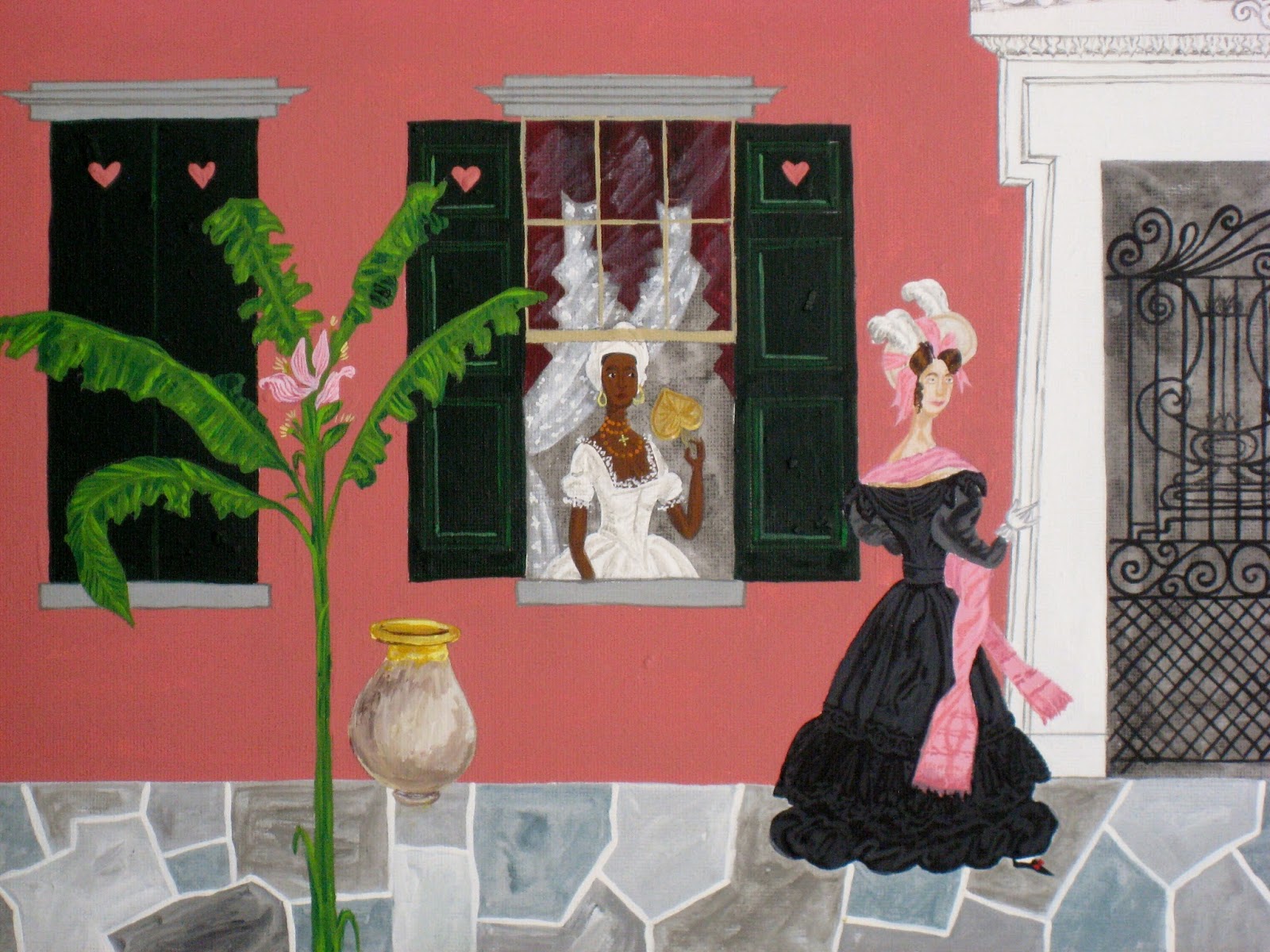
"Micaela Almonester de Pontalba visits Creole New Orleans in 1830"

"Micaela Almonester de Pontalba visits Creole New Orleans in 1830"

My latest Masterpiece is tilted "Micaela Almonester de Pontalba visits Creole New Orleans in 1830". It depicts Micaela Leonarda Antonia Almonester y Rojas, Baroness de Pontalba (November 6, 1795- April 20, 1874) a wealthy New Orleans-born Creole aristocrat, businesswoman, and real estate developer, and one of the most dynamic personalities of that city's history. Micaela is depicted in the latest fashion from Paris, walking down the flagstone sidewalk in front of a New Orleans Greek Revival house of a New Orleans mix race couple and child. On the flagstone sidewalk is a small a French Olive jar next to a miniature banana tree. And a Neoclassical wrought iron gated carriage passage known as a porte-cochère in New Orleans, connected the street to a rear courtyard. Over her head on a Neoclassical cast iron balcony, a white Creole father holding a Times-Picayune newspaper next to his mix race son with potted lemon and orange trees on the balcony. Below the Free woman of color mother looks out a open window holding a palm fan. 


Micaela Almonester de Pontalba visited New Orleans two times after her arranged marriage in 1811 to her 20-year-old cousin, Xavier Célestin Delfau de Pontalba, known as Celestin or "Tin Tin". Micaela was 15 at the time of her marriage. She traveled to New Orleans in 1830 and 1848, both years of Revolutions in France as well as with her husband family with a series of lawsuits against her.  In 1830, without her husband's permission, she went to New Orleans for an extended visit, taking the opportunity to travel around other parts of the United States. She stopped in Washington DC where President Andrew Jackson sent his own carriage and secretary of state Martin Van Buren to bring her to the White House as his guest. The celebrated Battle of New Orleans in which Jackson had defeated the invading British on 8 January 1815 had been fought on the grounds of the Chalmette Plantation belonging to her uncle and aunt. Upon her return to France the baron accused her of deserting Célestin; as a result she became a "virtual prisoner" of the de Pontalbas. In frustration, she took her children and transferred back to Paris where she began a series of lawsuits to obtain a separation from Célestin, but lost them due to the strict French marriage laws.


Micaela Baroness de Pontalba was perhaps the most interesting historical woman from New Orleans and one of the most dynamic personalities of that city's history. My association with the Micaela Baroness de Pontalba is I worked in the 1850 House Museum on Jackson Square. Two Summers ago I visited Mont-l'Évêque the moated, medieval de Pontalba chateau outside Senlis which was about 50 miles from Paris, still lived in by the Pontalba family. Micaela was born in New Orleans in November 6, 1795. Her mother a French Creole was Louise Denis de la Ronde a member of one of the most illustrious Creole families in Louisiana.. Her Spanish father, Andrés Almonester y Rojas was a Spanish civil servant of New Orleans.


 "an office rich in salary, perquisites, and business opportunities. He soon acquired wealth in it, or through it." Among his investments was a large tract of land downtown, purchased from Governor O'Reilly on perpetual lease. Upon the death of her Spanish father, Andrés Almonester y Rojas in 1798, Micaela, as his only surviving child, inherited a considerable fortune; although the estate was controlled by her mother, Louise Denis de la Ronde. Being the sole heiress to a considerable fortune, Micaela was likely the richest girl in the city of New Orleans if not the state of Louisiana. Following her marriage in 1811 to her French cousin, Xavier Célestin Delfau de Pontalba, she moved to France. The marriage was not successful and she became a virtual prisoner at the de Pontalba chateau near Senlis. 


Having failed to gain possession of her entire inheritance, her father-in-law, Baron de Pontalba shot her four times at point-blank range with a pair of dueling pistols and then committed suicide. She survived the attack, although her left breast and two of her fingers were mutilated by gunfire. Her husband, Cèlestin succeeded his father as baron, and Micaela was henceforth styled Baroness de Pontalba. She eventually obtained a legal separation from him. Micaela was responsible for the design and construction of the famous Pontalba Buildings in Jackson Square, in the heart of the French Quarter. In 1855, she built the Hôtel de Pontalba in Paris, where she lived until her death in 1874. Her life was worthy of an operatic plot, and eventually became one: Pontalba: a Louisiana Legacy, composed by Thea Musgrave. A play by Diana E.H. Shortes entitled The Baroness Undressed, and several novels, are also based on her dramatic life.


Sunday, June 15, 2014

Vieux Carré

Vieux Carré by Andrew LaMar Hopkins


Yesterday my painting titled Vieux Carré sold in Nadine Blakes shop located at 1036 Royal street here in in New Orleans. Nadine has sold over 16 of my paintings over the last 6 weeks. This has been exciting and a little scary as I can't paint 16 paintings in a 6 week period. I try to have on hand 30 of my paintings available at any time and now I'm down to under half that amount.  "Vieux Carré" showing a French Quarter Streetscape of about 1830. 


Depicts a street scene of the Old French Quarter in French "Vieux Carré".  I got the ideal to paint this painting walking down Royal street. The colors came first. I thought wouldn't a praline colored stucco building with light blue shutters look great on a French Quarter building. Next I picked out a building in the French Quarter I liked a two story Greek Revival Creole town house that I could use the colors on located on Burgundy street.

This is the balcony of the house in the French Quarter that I got the ideal to do Vieux Carré.


Vieux Carré

 3rd transform this scene back to the early 19th century. A free woman of color with a  tignon headdress sweeps the flagstone sidewalk in front of her early 19th century Creole cottage. A  tignon Creole of color street vendor sells Creole Delicacies to a French Creole lady on the flagstone sidewalk, a common sight in 19th and 20th century Creole New Orleans.


A tignon Creole of color street vendor sells Creole Delicacies to a French Creole lady on the flagstone sidewalk, a common sight in 19th and 20th century Creole New Orleans.


 This Antebellum street scene was common in 19th century New Orleans but New Orleans was the only place in America where black and white property owners live side by side. gens de couleur owned about one-third of the land in the French Quarter . Free woman of color obtained land in the Quarter and surrounding areas most by Plaçage.

 Plaçage was a recognized extralegal system in French and Spanish slave colonies of North America (including the Caribbean) by which ethnic European men entered into the equivalent of common-law marriages with women of color, of African, Native American and mixed-race descent. The term comes from the French placer meaning "to place with". The women were not legally recognized as wives but were known as placées; their relationships were recognized among the free people of color as mariages de la main gauche or left-handed marriages. 

They became institutionalized with contracts or negotiations that settled property on the woman and her children, and in some cases gave them freedom if enslaved. The system flourished throughout the French and Spanish colonial periods, reaching its zenith during the latter, between 1769 and 1803. It was most practiced in New Orleans, where planter society had created enough wealth to support the system. It also took place in the Latin-influenced cities of Natchez and Biloxi, Mississippi; Mobile, Alabama; St. Augustine and Pensacola, Florida] as well as Saint-Domingue (present-day Haiti). Plaçage became associated with New Orleans as part of its cosmopolitan society.


 A free woman of color with a  tignon headdress sweeps the flagstone sidewalk in front of her early 19th century Creole cottage a common sight in 19th and 20th century Creole New Orleans.

A typical French Quarter early 19th century Creole cottage. This type of house was obtained by Free woman of color with Plaçage.  


A Creole gentleman surveys the French Quarter from his Classical cast iron Veranda.


This painting also incorporates Neoclassical wrought iron alley gates. Wrought iron gas light. Cast iron urns planted with kumquats. A wood grained mahogany front door. A set of Old Paris porcelain vases can be seen in the window. A french olive jar on the flagstone sidewalk next to a potted kumquat. Banana trees can be seen over the brick wall.  On the flagstone sidewalk in front of the house is a granite carriage step is signed and dated by the artist.     

My exhibit is still up at Nadine Blake, If you are in New Orleans stop by. 1036 Royal St
New Orleans, Louisiana 70116


Thursday, December 16, 2010

Latest masterpiece dropped off at the Art Gallery


 "Garçonnière"


Last Friday I dropped off 4 of the 7 painting I hand been working on. Today I dropped two more and was happy to find out that one more of my painting had sold this week "Greek Revival Dandy # 1. This painting showing a young fashionably dressed gentleman in front of a Greek Revival doorway.


Greek Revival Dandy # 1


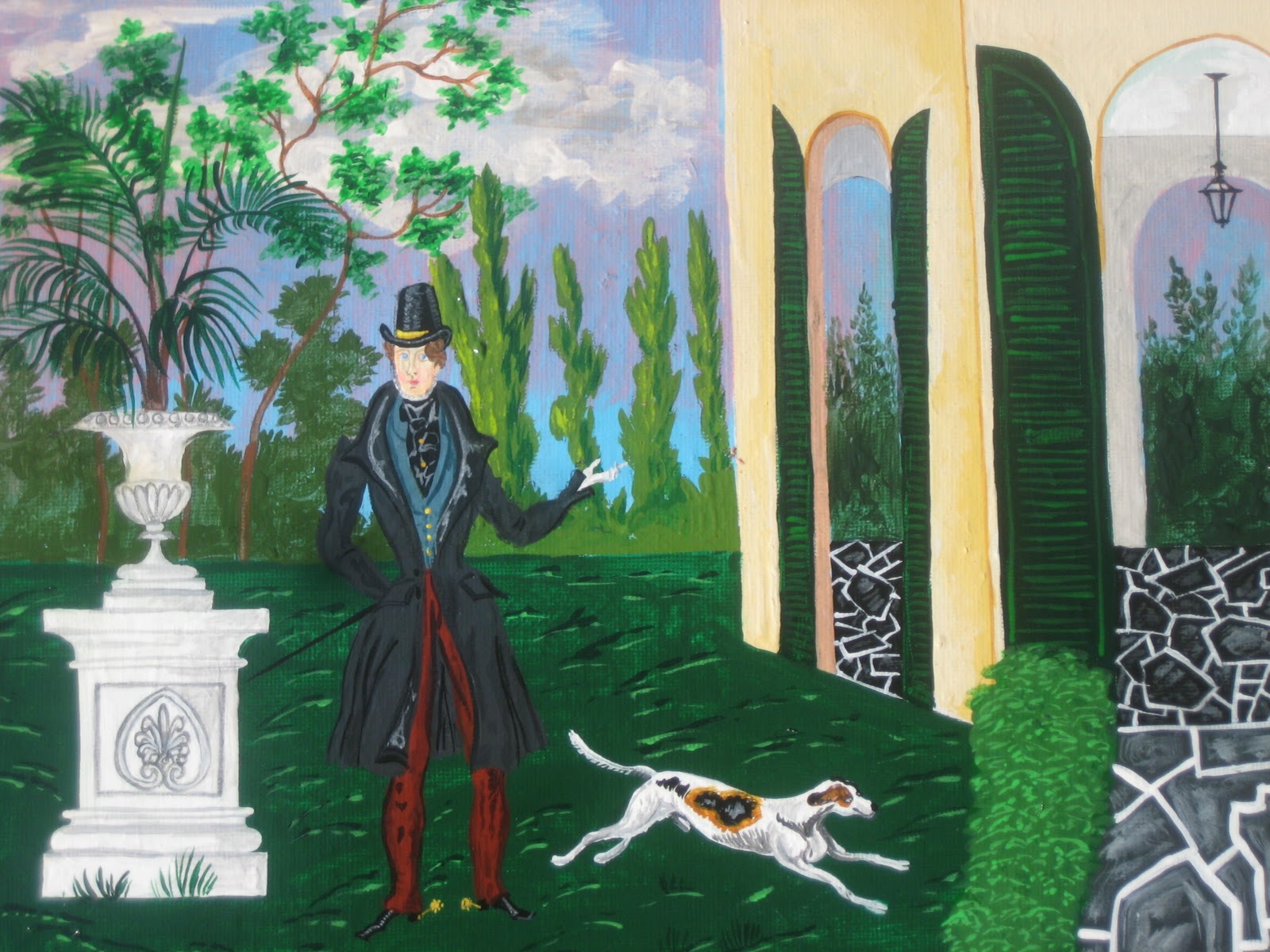
My latest masterpiece titled "Garçonnière" features a Antebellum French Vernacular architecture garçonnière a bachelor's apartment or quarters. In the French Creole South when boys in the house became teenagers they were moved out of the main home into separate quarters on the property so they could entertain and come and go without disturbing the main house ( mostly the female ocupants). This garçonnière is inspired by one at Houmas House Plantation and Gardens located in Louisiana.

My painting of a garçonnière is inspired by one at Houmas House Plantation and Gardens located in Louisiana


Around the garçonnière we have a French Creole teenage garçon fashionably dressed in a period of the 1830's gesturing to his home. His dog runs past him after a riding party on the other side of the garçonnière. The garçon stands by a classical stucco pedestal with Greek Palmetto/honeysuckle motif with a cast iron Medici style urn with ferns on top, typical garden ornaments of the Romantic period.

A French Creole teenage garçon fashionably dressed in the period of the 1830's gesturing to his home. His dog runs past him after a riding party on the other side of the garçonnière.


A riding party on the other side of the garçonnière.


"Garçonnière" framed and at the Art Gallery


Another painting I finished is a painting of a Angel titled "Mobile Angel of Abundance". Showing a Angel is flowing robe holding a golden shell of Abundance. She is in a colorful sky.

"Mobile Angel of Abundance"


My paintings at the Gallery

Friday, December 10, 2010

Latest artwork delivered to the Gallery today

Latest artwork delivered to the Gallery today

Mobile Free boy of color

Tonight is the Christmas Artwalk here in Mobile, Alabama, All of the Art Gallery's downtown are open late tonight. I was suppose to finish 7 paintings by today but only finished 3 oh well. I was happy to find out while I was installing my painting at the Gallery that I had sold one titled " Mobile Free boy of color" I have a early blog about him. The three new paintings from the top down "Greek Revival Gentleman", "18th century New Orleans", and "Alabama Camellia Belle.

Greek Revival Gentleman


Detail of Greek Revival Gentleman

"Greek Revival Gentleman", shows a dapper Free man of color standing outside of a Greek Revival town house from the 1840's period. He is fashionably dress with Top hat and stick. The lavender stucco Town house sits on a brownstone foundation with oval cast iron air vents. The Quincy granite steps sports classical cast iron urns with nicely manicured kumquat topiaries.  The deeply set panel Greek Revival doorway has decorative anthemion details on the top.


18th century New Orleans

18th century New Orleans

"18th century New Orleans", depicts a New Orleans Creole aristocrat from the period of French Queen Marie Antoinette standing on her French Quarter balcony holding a exotic parrot. She is dressed in a style fashionable of the 1780's. A mid-night blue satin dress with turban head dress sporting a feather. She is holding on to a Baroque style wrought iron balcony fashionable in New Orleans with Spanish iron smiths in the late 18th century. The decorative stucco building features classical pilasters and door surrounds. On the balcony is a potted orange tree a symbol of wealth.

Alabama Camellia Belle

Detail of Alabama Camellia Belle

"Alabama Camellia Belle" Shows a Alabama Belle in a Romantic Garden with two large Old World style Terracotta Pots with white & red stripe Camellia bushes. The Camellia flower is the state flower of Alabama. The Southern Belle has a ball gown of the 1840's period covered in red Camellias. She is standing on flagstone payment under a Classical Greek Revival wrought iron arbor.   

Monday, September 13, 2010

Greek Revival Dandies!!!

Greek Revival Dandy # 1

Sorry for the time I have been away. I have been so busy. I got into a Co-op Art Gallery. We had a grand opening last Friday. I have been busy down to the last min working on art and my space in the Gallery. Hopefully I can get part 3 of Hurricane Katrina out this week. I'm working on a series of paintings called "Greek Revival dandies" Here are one and two of a twenty part series. In each painting I show a fashionably dress young beau's in front of a Neoclassical Federal or Greek Revival doorway.


Greek Revival Dandy # 2
                                                                                    

Sunday, June 13, 2010

Mural I painted in my New Orleans home

Monuments of the Mississippi river

This is a wall mural I painted to look like 1830's French hand-blocked panoramic wallpaper. Titled Monuments of the Mississippi river. The mural shows elegant stately buildings along the Mississippi river starting from New Orleans to Natchez Mississippi with plantation homes in between, along with the people from the period. French Creoles, slaves, Free people of color and Indians.


Windy Hill Manor was constructed in the 1790's by Benijah Osmun. in the center with a Concord visible to the left, residence of the first Spanish Governor, Don Manuel Gayoso de Lemos, who built the house in 1794. On the mantel a collection of Old Paris porcelain.


Indians at play over a 1830's Louisiana walnut drop leaf table with Old Paris porcelain punch bowl and vase


The dance of Free woman of color with Louisiana plantations in background

 
Funeral procession and rosewood Rococo Revival chairs with original upholstery attributed to Alexander Roux from a South Carolina plantation. Primitive Louisiana Cypress tapered leg table with Paris porcelain vase.

 
Louisiana plantations, Free woman of color and pegioners brick octagonal building for pigeons. With rosewood Rococo Revival chairs with original upholstery attributed to Alexander Roux from a South Carolina plantation. Primitive Louisiana Cypress tapered leg table with Paris porcelain vase.

 
Natchez on the bluff being worked on


Detail of Indians picking bananas. 1840's French Boulle and ormolu clock in the Moorish style Old Paris porcelain.


Natchez on the bluff being worked on and 1840's French Boulle and ormolu clock in the Moorish style Old Paris porcelain and makeup Shields

 
New Orleans & Place d'Armes

 
Over-mantel hung with 1840's portrait of a Creole woman