Showing posts with label Creole cottage. Folk art artist. New Orleans. Show all posts

Thursday, February 1, 2018

"Tonton de Blanc the Marie Antoinette of Louisiana" by Andrew LaMar Hopkins

"Tonton de Blanc the Marie Antoinette of Louisiana" by Andrew LaMar Hopkins 

My latest masterpiece is titled "Tonton de Blanc the Marie Antoinette of Louisiana" 11 x 14, Available. At a Christmas party I met a ancestor of the fabulous Tonton de Blanc who told me her fascinating story of this amazing lady. I thought at that time I needed to paint her. Tonton de Blanc was the Queen of beauty and fashion of late 18th century Saint Martinville, Louisiana. In my painting Tonton is standing in her Saint Martinville home holding a basket of fruit. The room is furnished with Louisiana made Creole furniture, like the Mahogany Cabriole Leg Armoire to the right and the Louisiana mahogany one drawer side table to the left. On the Creole table is a 18th century cobalt and ormolu Sèvres porcelain vase of garden flowers. 

Over the table is a oil portrait French Queen Marie Antoinette by court painter Elisabeth Vigee-Lebrun. While in France Tonton de Blanc was in the Court of Marie Antoinette and Louis XVI. On top pf the armoire are wallpaper hat boxes. The French doors have a Toile de Jouy and lace drapery treatment. Tonton stands on a imported marble floors that includes yellow Royal Siena marble. Tonton de Blanc had one of the prettiest complexions in the world, all lily and rose, and what care she took of it ! She never went into the yard or the garden without a sunbonnet and a thick veil. 


Yet for all that her jealous critics said she was good and sensible, and would forget everything, even her dressing to help anyone in trouble. Tonton de Blanc was Louisiana Aristocracy and the Queen bee of fashion of 18th century Saint Martin. She designed fashionable hats made by milliners using local materials like split palmetto finished off with silk flowers and ribbons. After Tonton debut her fashions in the saint Marin church ,The next Sunday you could see as many hats as the milliner had time to make, and before the end of the month all the women of Saint Martinville were wearing palmetto hats furnished at a high 18th century cost of $25.00 each! You can read more about Tonton de Blanc in "Strange True Stories of Louisiana" by George Washington Cable. 

Thursday, April 20, 2017

"Creole First Step in Life" Creole Folk art by Andrew LaMar Hopkins

"Creole First Step in Life" Available 8 x 10.

"Creole First Step in Life" depicts a moment when a child takes his first steps surrounded by his mix race Creole Antebellum family of the early 19th century in a Creole Federal interior. The interior has Louisiana made Creole furniture like the Inlaid Figured Mahogany Creole armoire, Cabriole leg table  and Louisiana made mahogany and red leather Campeche chair. The Campeche chair, also known as a "plantation chair," is a type of lounge chair popular in Latin America, the Caribbean, and the American South. Its name comes from the Campeche region of Mexico's Yucatán Peninsula, which manufactured and exported the chairs in the 18th and 19th centuries. The family is standing on a ingrain carpet or Kidderminster Carpet. A reversible flat weave carpet popular from the 18th century to the early 19th century. This form of carpeting has no pile and the pattern is shown in opposing colors on both faces, making it possible to turn the carpet over when one side was worn or soiled. 

Over the Campeche chair is a portrait of a ancestor in carved gilt-wood frame. Creoles were very proud of family portraits and prominently hung them for display. The room has wainscoting embellished with molding. The drapery treatment is French from Meubles et Objets de Goût by Pierre de La Mésangère. La Mesangere, a symbol of a certain elegance of the ancien regime, became a famous figure in the Parisian landscape. His magazine was the goal of his life; He wrote all the articles, accumulating notes for a Dictionary of luxury, He was especially an excellent newspaper editor, literary columnist and well-informed socialite, knowing how to manage his stock of engravings, which were very popular in Federal America for furniture and drapery design. Decorative arts in the room on Cabriole Leg Table include a Early 19th century Federal Lighthouse clock. 

A French Empire silver coffee pot. A pair of Paris porcelain coffee cans and A gold Old Paris vase. Most Creole homes are modest buildings from the outside. Creole did not like to show off with the exteriors of their buildings like the Americans flooding into Louisiana at this time. But it was said that many Creole homes were furnished and decorated rich and elegant inside like this interior. Louisiana’s eighteenth- and nineteenth-century Creoles were a permissive, fun-loving, and status-conscious people with a fondness for European courtly customs. These included good manners, lavish hospitality, close family ties, dancing, and gambling. Creoles also practiced the widespread European custom of dueling—over both important and trivial matters. In addition, they sanctioned a double moral standard which placed women on pedestals but encouraged young men to sow their wild oats. 
Available 8 x 10.


Saturday, April 23, 2016

My Creole Folk art painting titled "Creole Banjo player"

"Creole Banjo player" By Andrew LaMar Hopkins 20 X 16 Available.


"If I were called upon to define briefly the word Art, I should call it the reproduction of what the senses perceive in nature, seen through the veil of the soul." Paul Cezanne. 


My painting titled "Creole Banjo player" shows a colorful 1840's French Quarter street scene of a Creole Banjo player making street music with a Street fruit seller and a dancing Creole Lady. The Banjo player is in front of a late 18th century Creole two bay cottage of brick between post construction covered in stucco and roofed with steeply pitched hip roof. The house next to the Creole cottage would have been built during the Transitional Period, 1820-35. American architects and builders were introducing the Federal style into the Creole city of New Orleans, often using red brick, white trim, freestone columns and green blinds. A style brought from the East Coast. The wrought iron balcony on the building is in the popular "Running Dog" pattern, a popular pattern used on French Quarter buildings of the period.


The instrument proper to them, "wrote Thomas Jefferson in his Notes on the State of Virginia, "is the Banjar, which they brought hither from Africa." "They" were, of course, African slaves, and musicologists today agree with Jefferson's assertion about the origins of the instrument we now know as the Banjo. Just as music is played on the streets of Creole New Orleans today with dancing in the streets. Not much has changed from the 19th century when music and dancing on the streets was a daily occurrence. The African influence on New Orleans music can trace its roots at least back to Congo Square in New Orleans in the first half of the 19th century, when slaves and Free people of color would congregate there to play music and dance on Sundays. African music was played as well as local music, This early African music inspired local Whites as Louis Moreau Gottschalk. A Creole child prodigy.


Along with such popular European musical forms popular in the city, perhaps most notably the brass band traditions, the cultural mix laid the groundwork for the New Orleans musical art forms to come. In 1838 a local paper—the daily Picayune—ran a scathing article complaining about the emergence of brass bands in the city, which it stated could be found on every corner. The painting also shows a 2-story Creole Federal house lived in by a mix-race couple. When French settlers and traders first arrived in these colonies, the men frequently took Native American women as their concubines or common-law wives. When African slaves were imported to the colony, the colonists took African women as concubines or wives. In the period of French and Spanish rule, men tended to marry later after becoming financially established. This tradition continued well into the 19th century after the 1803 Louisiana Purchase by America. Acrylic on canvas 20 X 16 Available.


A Creole Banjo player making street music with a dancing Creole Lady.

A Street fruit seller 

A turbaned Free woman of color looks out of her window. 


mix-race New Orleans couple common in 18th & 19th century New Orleans. 

New Orleans Free woman of color obtained land in the Quarter and surrounding areas most by Plaçage. Plaçage was a recognized extralegal system in French and Spanish slave colonies of North America (including the Caribbean) by which ethnic European men entered into the equivalent of common-law marriages with women of color, of African, Native American and mixed-race descent. The term comes from the French placer meaning "to place with". The women were not legally recognized as wives but were known as placées; their relationships were recognized among the free people of color as mariages de la main gauche or left-handed marriages. They became institutionalized with contracts or negotiations that settled property on the woman and her children, and in some cases gave them freedom if enslaved. The system flourished throughout the French and Spanish colonial periods, reaching its zenith during the latter, between 1769 and 1803. It was most practiced in New Orleans, where planter society had created enough wealth to support the system. 

 The Creole cottage to the left has two French doors. French Colonial homes in the American South commonly had stuccoed exterior walls covering soft local brick made from clay and mud from the Mississippi river banks. 


French Colonial is a style of architecture used by the French during colonization. It is believed to have been primarily influenced by the building styles of French Canada and the Caribbean. Most buildings constructed during the French colonial period utilized a heavy timber frame of logs installed vertically on a sill, poteaux-sur-sol, or into the earth, poteaux-en-terre. An infill of lime mortar or clay mixed with small stones (pierrotage) or a mixture of mud, moss, and animal hair (bousillage) was used to pack between the logs. Many times the infill would later be replaced with brick. This method of construction was used in the Illinois Country as well as Louisiana.

French Colonial roofs were either a steep hipped roof, with a dormer or dormers, or a side-gabled roof. 

Tuesday, April 19, 2016

Early morning still life

Morning sunlight on a 19th century Copeland Parian ware bust depicting Diana goddess of the hunt and a cut and etched glass urn full of shells. 

Sunday, June 15, 2014

Vieux Carré

Vieux Carré by Andrew LaMar Hopkins


Yesterday my painting titled Vieux Carré sold in Nadine Blakes shop located at 1036 Royal street here in in New Orleans. Nadine has sold over 16 of my paintings over the last 6 weeks. This has been exciting and a little scary as I can't paint 16 paintings in a 6 week period. I try to have on hand 30 of my paintings available at any time and now I'm down to under half that amount.  "Vieux Carré" showing a French Quarter Streetscape of about 1830. 


Depicts a street scene of the Old French Quarter in French "Vieux Carré".  I got the ideal to paint this painting walking down Royal street. The colors came first. I thought wouldn't a praline colored stucco building with light blue shutters look great on a French Quarter building. Next I picked out a building in the French Quarter I liked a two story Greek Revival Creole town house that I could use the colors on located on Burgundy street.

This is the balcony of the house in the French Quarter that I got the ideal to do Vieux Carré.


Vieux Carré

 3rd transform this scene back to the early 19th century. A free woman of color with a  tignon headdress sweeps the flagstone sidewalk in front of her early 19th century Creole cottage. A  tignon Creole of color street vendor sells Creole Delicacies to a French Creole lady on the flagstone sidewalk, a common sight in 19th and 20th century Creole New Orleans.


A tignon Creole of color street vendor sells Creole Delicacies to a French Creole lady on the flagstone sidewalk, a common sight in 19th and 20th century Creole New Orleans.


 This Antebellum street scene was common in 19th century New Orleans but New Orleans was the only place in America where black and white property owners live side by side. gens de couleur owned about one-third of the land in the French Quarter . Free woman of color obtained land in the Quarter and surrounding areas most by Plaçage.

 Plaçage was a recognized extralegal system in French and Spanish slave colonies of North America (including the Caribbean) by which ethnic European men entered into the equivalent of common-law marriages with women of color, of African, Native American and mixed-race descent. The term comes from the French placer meaning "to place with". The women were not legally recognized as wives but were known as placées; their relationships were recognized among the free people of color as mariages de la main gauche or left-handed marriages. 

They became institutionalized with contracts or negotiations that settled property on the woman and her children, and in some cases gave them freedom if enslaved. The system flourished throughout the French and Spanish colonial periods, reaching its zenith during the latter, between 1769 and 1803. It was most practiced in New Orleans, where planter society had created enough wealth to support the system. It also took place in the Latin-influenced cities of Natchez and Biloxi, Mississippi; Mobile, Alabama; St. Augustine and Pensacola, Florida] as well as Saint-Domingue (present-day Haiti). Plaçage became associated with New Orleans as part of its cosmopolitan society.


 A free woman of color with a  tignon headdress sweeps the flagstone sidewalk in front of her early 19th century Creole cottage a common sight in 19th and 20th century Creole New Orleans.

A typical French Quarter early 19th century Creole cottage. This type of house was obtained by Free woman of color with Plaçage.  


A Creole gentleman surveys the French Quarter from his Classical cast iron Veranda.


This painting also incorporates Neoclassical wrought iron alley gates. Wrought iron gas light. Cast iron urns planted with kumquats. A wood grained mahogany front door. A set of Old Paris porcelain vases can be seen in the window. A french olive jar on the flagstone sidewalk next to a potted kumquat. Banana trees can be seen over the brick wall.  On the flagstone sidewalk in front of the house is a granite carriage step is signed and dated by the artist.     

My exhibit is still up at Nadine Blake, If you are in New Orleans stop by. 1036 Royal St
New Orleans, Louisiana 70116


Friday, November 8, 2013

The Creole cottage of John James Audubon

The Creole cottage of John James Audubon, by Folk artist Andrew LaMar Hopkins


The Creole cottage of John James Audubon a painting I did for a local show in a French Quarter gallery that carries my paintings was done almost last minute. I was told months in advance by the Gallery owner to put aside some of my period room interior paintings for the October show. Then a little less then a month before the show I was called and told that the October show had a bird theme. She said I don't like to tell Artist what to paint but! I thought why not incorporate birds into my interior paintings. By painting the New Orleans Gallery/Living space of the greatest Bird painter in the World, That just happen to live in New Orleans French Quarter. This is how the painting "The Creole cottage of John James Audubon" came about. 

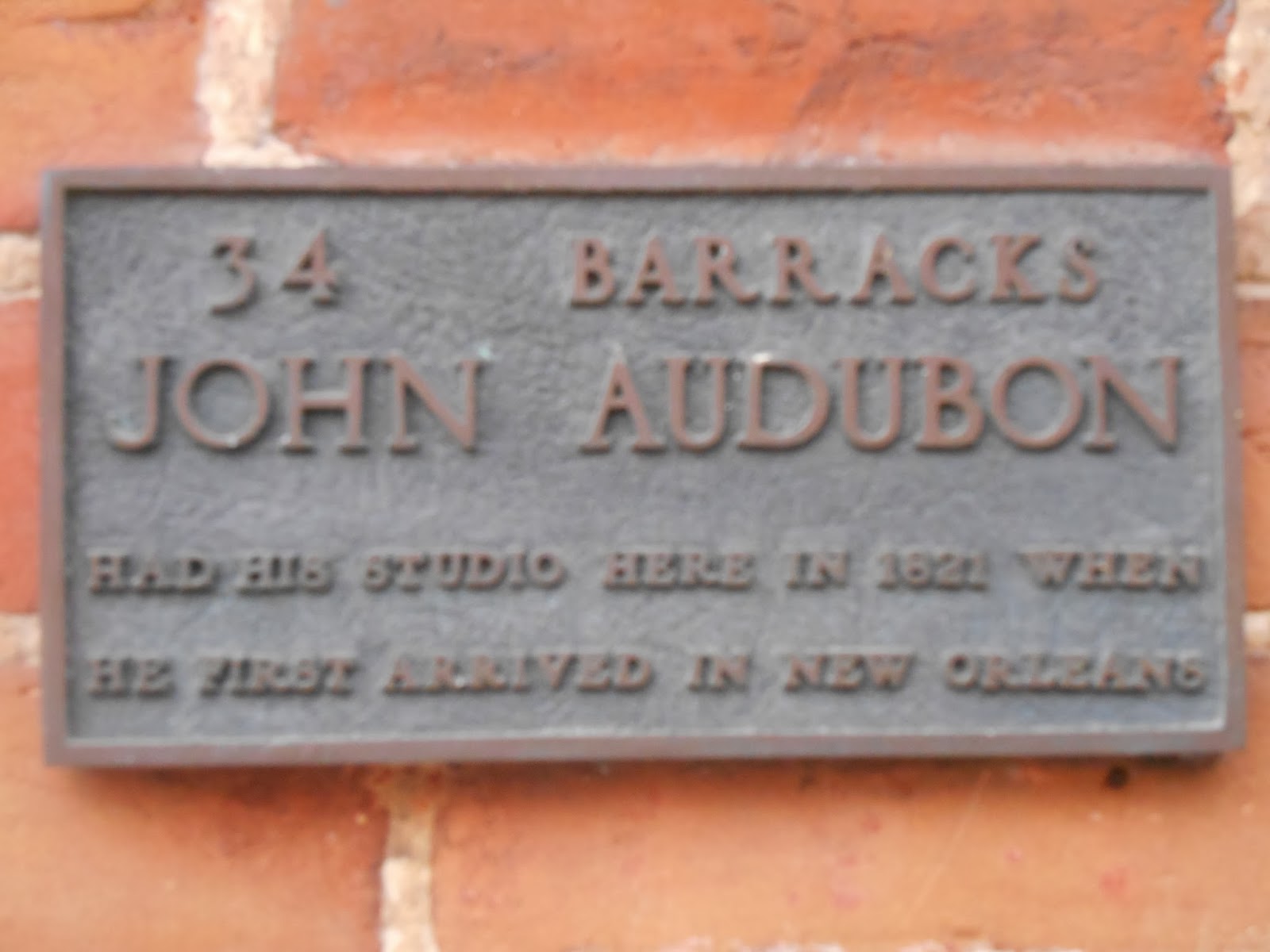
The first place Audubon rented in New Orleans French Quarter was a Creole Cottage owned by a free woman of color on Barrack street. It was not clear if he rented the whole cottage or half of it. The space came with a wisher woman/housekeeper.


Audubon rented a Creole Cottage located at 509 Dauphine street for $17 a month


Incorporating Audubon into my interior painting had been something I wanted to do for some time. So when I got the call from the Gallery owner I knew just what to paint. When you live in New Orleans Louisiana  and are a Historical Folk artist, history painting incorporating local famous persons is endless as Louisiana's rich history is so rich,different and colorful from the rest of America. 


What people don't know is I don't just paint a painting I do a lot of research for all of my painting most of the time before I pick up a paint brush. This was the same with the Audubon painting. Audubon kelp a daily journal  that he wrote in almost every day. To get a better ideal of what his living space might have looked like I read his New Orleans years 1820-1822. During this time Audubon lived in three locations in the French Quarter. 

Audubon rented a Creole Cottage located at 509 Dauphine street for $17 a month


John James Audubon (Jean-Jacques Audubon) (April 26, 1785 – January 27, 1851) was a French-American ornithologist, naturalist, and painter. He was notable for his expansive studies to document all types of American birds and for his detailed illustrations that depicted the birds in their natural habitats. His major work, a color-plate book entitled The Birds of America (1827–1839), is considered one of the finest ornithological works ever completed. Audubon identified 25 new species.


Audubon rented a Creole Cottage located at 509 Dauphine street for $17 a month


On October 12, 1820, Audubon started into Mississippi, Alabama, and Florida in search of ornithological specimens. He traveled with George Lehman, a professional Swiss landscape artist. The following summer, he moved upriver to the Oakley Plantation in the Felicianas, where he taught drawing to Eliza Pirrie, the young daughter of the owners. Though low paying, the job was ideal, as it afforded him much time to roam and paint in the woods. (Located at 11788 Highway 965, between Jackson and St. Francisville, the plantation is now the Audubon State Historic Site.) Audubon called his future work Birds of America. He attempted to paint one page each day. Painting with newly discovered technique, he decided his earlier works were inferior and re-did them. He hired hunters to gather specimens for him. Audubon realized the ambitious project would take him away from his family for months at a time.

John James Audubon Self Portrait. This is close to what Audubon looked like when he was in New Orleans

Audubon moved to France as a boy due to the rising unrest in Saint-Domingue from African slaves. As a young man living in France Audubon grew up to be a handsome and gregarious man. He played flute and violin, and learned to ride, fence, and dance. A great walker, he loved roaming in the woods, often returning with natural curiosities, including birds' eggs and nests, of which he made crude drawings.


American naturalist and ornithologist John James Audubon (1785-1851)

Audubon by John Syme, 1826


Audubon sometimes used his drawing talent to trade for goods or sell small works to raise cash. He made charcoal portraits on demand at $5 each and gave drawing lessons. In 1823 Audubon took lessons in oil painting technique from John Steen, a teacher of American landscape, and history painter Thomas Cole. Though he did not use oils much for his bird work, Audubon earned good money painting oil portraits for patrons along the Mississippi. (Audubon's account reveals that he learned oil painting in December 1822 from Jacob Stein, an itinerant portrait artist, and after they had enjoyed all the portrait patronage to be expected in Natchez, Mississippi during January–March 1823, they resolved to travel together as perambulating portrait-artists.)


Detail of The Creole cottage of John James Audubon

After reading Audubon's journal to get a since of what his living space might have looked like. It was hard to come up with a ideal of what his living spaces might have looked like as he talked about birds 90% of the time. Audubon live and had his studio in 3 different places in the French Quarter. The first place Audubon rented was a Creole Cottage owned by a free woman of color on Barrack street. It was not clear if he rented the whole cottage or half of it. The space came with a wisher woman/housekeeper. It was also not clear if this space was furnished or not but it might have been. Audubon did not get along with his landlord the Free woman of color. IN June of 1821 Audubon and his pupil assistant, John Mason left New Orleans and traveled upriver to the Puritan influence region of St. Francisville to take a job at Oakley Plantation. 

Detail of The Creole cottage of John James Audubon

Audubon wore typical frontier clothes and moccasins "and a ball pouch, a buffalo horn filled with gunpowder, a butcher knife, and a tomahawk on his belt.

 Audubon had great respect for Native Americans: "Whenever I meet Indians, I feel the greatness of our Creator in all its splendor, for there I see the man naked from His hand and yet free from acquired sorrow." Audubon also admired the skill of Kentucky riflemen and the "regulators", citizen lawmen who created a kind of justice on the Kentucky frontier. In his travel notes, he claims to have encountered Daniel Boone.

Gyrfalcon , Falco rusticolus, hand-colored engraving

American Flamingo


Detail of The Creole cottage of John James Audubon


Arriving at Oakley Plantation on June 18, 1821, the young aspiring naturalist John James Audubon wrote: "The rich magnolias covered with fragrant blossoms, the holly, the beech, the tall yellow poplar, the hilly ground and even the red clay, all excited my admiration." Audubon's stay at Oakley lasted only four months, but he painted 32 of his famous bird pictures here and developed a love for the beautiful West Feliciana Parish. Mrs. Lucy Pirrie brought the young Audubon to Oakley as a tutor for her daughter, Eliza. The arrangement required that Audubon spend half his time teaching drawing to Eliza, but he was otherwise free to roam the woods and work on his naturalistic paintings. For this Audubon was to receive 60 dollars a month plus room and board for himself and his 13-year-old pupil assistant, John Mason. His teacher-artist arrangement was short-lived due to a misunderstanding with Mrs. Pirrie. Only four months after his arrival, Audubon returned to New Orleans.


A graceful emblem of plantation society in the Americas, the Campeche chair is characterized by a lateral nonfolding curule base and a reclining back and seat made of embossed leather.

Detail of The Creole cottage of John James Audubon


Upon his return Audubon rented a "chamber garnie" Furnish room on Rue Saint Ann No 29 for $16 a month. Within a month or two Audubon's wife and boys were arriving in New Orleans and he rented a Creole Cottage located at 509 Dauphine street for $17 a month. Audubon made good money in New Orleans as a artist. He charged $2 a hour for drawing lessons, The higest in New Orleans at the time and charcoal portraits on demand at $5 each also the highest priced in the city. Audubon talked about other artist in the city of New Orleans not liking him.  Audubon was a Creole from Haiti but he told local Creoles that he was born on a plantation near Mandeville to mask his illegitimate birth.


A American Federal armchair 

Fancy painted drapery cornice 


 Drapery cornice over the window is also painted and gilded with a Neoclassical patterned painted on it

 Drapery cornice over the window is also painted and gilded with a Neoclassical patterned painted on it


Detail of The Creole cottage of John James Audubon

My painting "The Creole Cottage of John James Audubon" Shows the most famous last home and studio of Audubon. The early 19th century Creole Cottage located at 509 Dauphine street in the French Quarter. This Cottage is still standing and is a high end hotel now. In this cottage Audubon talks about getting it ready for his wife and children. Audubon does not go into detail about the furnishings of this house but he did compare his earlier humble lodging with the fine furnishings at Oakley plantation. He said that most of his furniture was painted compared to the fine polished Mahogany of Oakley plantation. He was talking about the first cottage he rented that might have already been furnished. Because we really don't know how Audubon's studio/home was furnished I have to guess and use with little clues I have to go on. The Dauphine street house would have been different because he was getting it ready for his family.


18th century bird cage 


Painted end table 

Baltimore fancy painted card table 

New Your Federal sofa

Detail of The Creole cottage of John James Audubon


 I think much of the furnishing for the Dauphine street cottage would have been bought by Audubon second had and would have been 20 plus years old. Most of the art and decoration would have been done by Audubon himself to save money and to show off his talent. Over the sofa we have Thomas Sully gilt framed watercolors of Audubon's birds. The most famous being the American Flamingo. Over the watercolors mounted on the wall is a large sea Tortoiseshell and two taxidermy ducks. Audubon learn modern taxidermy from Charles-Marie D'Orbigny in France in 1805. Charles-Marie improved Audubon's taxidermy skills and taught him scientific methods of research. Scattered around the room are taxidermy birds under glass domes as well as live birds in cages. The plaster walls of this room is painted indigo blue a popular color made from Louisiana's indigo industry. The only up to date piece of furniture in the room is the Federal sofa New York circa 1820 flanked by a pair of early 19th century painted fancy end tables, one holding a goldfish bowl. The drapery cornice over the window is also painted and gilded with a Neoclassical patterned painted on it.  One of the finest pieces of furniture in the room would be the American Federal satin wood and mahogany Secretary Desk Bookcase circa 1800.  Under the window is a mahogany American Federal card table with eagle support circa 1805. On the sisal woven rug we have a 18th century Creole walnut Cabriole leg table with Hurricane globe, brass candlestick, playing cards, green glass wine bottle, wine glass and clay pipe on the table top. A red leather 18th century Campeche chair. A graceful emblem of plantation society in the Americas, the Campeche chair is characterized by a lateral nonfolding curule base and a reclining back and seat made of embossed leather. And a early 19th century red leather American Federal arm chair. The mixture of American East Coast Federal furniture with local French Creole furnishings would have appealed to his Anglo-Sexton and Creole clients.   

Detail of The Creole cottage of John James Audubon


The Creole cottage of John James Audubon SOLD 

Audubon died in New York on January 27, 1851, at sixty-six years of age. 
Today he is, after La Fayette, the best known Frenchman in the United States, and his portrait hangs in the White House. A symbol of American ecology, he gave his name to one of the most important nature conservancy organisations in the USA, "The Audubon Society." Created in 1886, the society is headquartered in the heart of Manhattan and has more than 500,000 members.