Showing posts with label Alabama. Show all posts

Sunday, March 15, 2015

Artist Andrew LaMar Hopkins


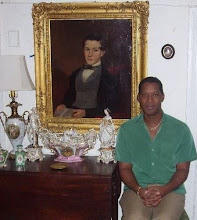
Andrew LaMar Hopkins

THOM BENNETT PHOTOGRAPH
An avowed Francophile and person of Creole descent, artist Andrew LaMar Hopkins is passionate about France and its cultural influence in Louisiana.  Over the past 17 years, he has visited Paris 30 times and created 300 works depicting historic New Orleans residences and their inhabitants. “I went to Paris the first time when I was 20,” says Hopkins, whose family moved from Mobile, Alabama, to New Orleans during his teens. “I felt like [France] is where I should have been born.”


Hopkins’ affinity for all things French began in childhood. As a boy he used clay to create accurate miniatures of 18th- and 19th-century antiques and later expanded his miniature-métier to include complete rooms, featuring details such as cornice moldings and marbleized mantels. Today, he paints 18th and 19th century interiors and people and describes his work as “historical folk outsider art.” His period subject matter and simple, non-dimensional renderings of people are reminiscent of the Early American Primitive School of portrait painters, a comparison he welcomes as an admirer of renowned painters Joshua Johnson and Julien Hudson (both of mixed race heritage like Hopkins himself). “As I began to paint, people told me my style was Naïve,” recalls the self-taught artist, who juxtaposes his Naïve human forms with meticulously replicated decorative elements and vivid colors true to the fashions of the time.

Five years ago, Hopkins found that his historic tableaus intersected his own life. “I discovered I was kin to a major Creole family whose French ancestors came from Tours, France, in 1710,” he says. On his paternal side, he is a direct descendent of Nicolas Baudin, who obtained a land grant in 1710 for an island south of Mobile, which he named Mon Louis after his hometown of Mont Louis, France. As a descendent of Baudin, he also is related to several French governors of Louisiana.

Hopkins’ paintings often include famous Creoles of New Orleans such as John James Audubon and Marie Laveau and are displayed in such well-known local establishments as Dooky Chase’s Restaurant and Lucullus. New works are for sale at Nadine Blake and Rue Royale Gallery. He also works by commission. Current commissions include an 1855 Creole townhouse in Treme (built for Louise Vitry, a free woman of color) and the Jacques Dupré house, a historic plantation in Pointe Coupée Parish.

find his work


Saturday, July 21, 2012

Miniature New Orleans 1850's Creole bedroom

Miniature New Orleans 1850's Creole bedroom

In my younger days I played with clay and became good at creating antiques out of clay  in miniature, and painting the clay to look like the various materials I was coping . As I child I could make a Ancient Roman Village or a Southern Antebellum town out of clay on the top of a table. In the late 1990's I was making period rooms in miniature. 


Prudent Mallard , 1853

This room Creole New Orleans bedroom from the 1850's was completed in 1999. It show a Louisiana Creole bed chamber dating from the 1850's. The architecture of the room is of the Classical Greek Revival period and dates to the 1830's. The Greek Key doorways in the room have ornate  entablatures toped with classical anthemion's. The paneled doors are wood grained to look like rich flamed mahogany and birds eye maple. The baseboard and the Creole mantel are marbleized. At the top of the walls is a classical cornice molding. The transoms are made up of Neoclassical Bow and arrow design


The furniture in the room is copied from Mid 19th century pieces by Creole New Orleans most renown cabinetmaker Prudent Mallard. Prudent Mallard was born in Sevres, France, in 1809, the son of Parisian mother whose husband was a Scotsman. He emigrated to America in the 1830's first living in New York city and then moving to New Orleans. Mallard became the most popular cabinetmaker in New Orleans during the antebellum period and shipped his furniture all over the South.   He died 6 AUG 1879 in New Orleans, having married Augustine Andrea Beltram with whom he had seven children. The rosewood Rococo Revival bedroom suit of furniture consists of a half tester bed, dressing table, armoire, shaving stand & pray due ( a chair to pray on at night).


Thursday, December 16, 2010

Latest masterpiece dropped off at the Art Gallery


 "Garçonnière"


Last Friday I dropped off 4 of the 7 painting I hand been working on. Today I dropped two more and was happy to find out that one more of my painting had sold this week "Greek Revival Dandy # 1. This painting showing a young fashionably dressed gentleman in front of a Greek Revival doorway.


Greek Revival Dandy # 1


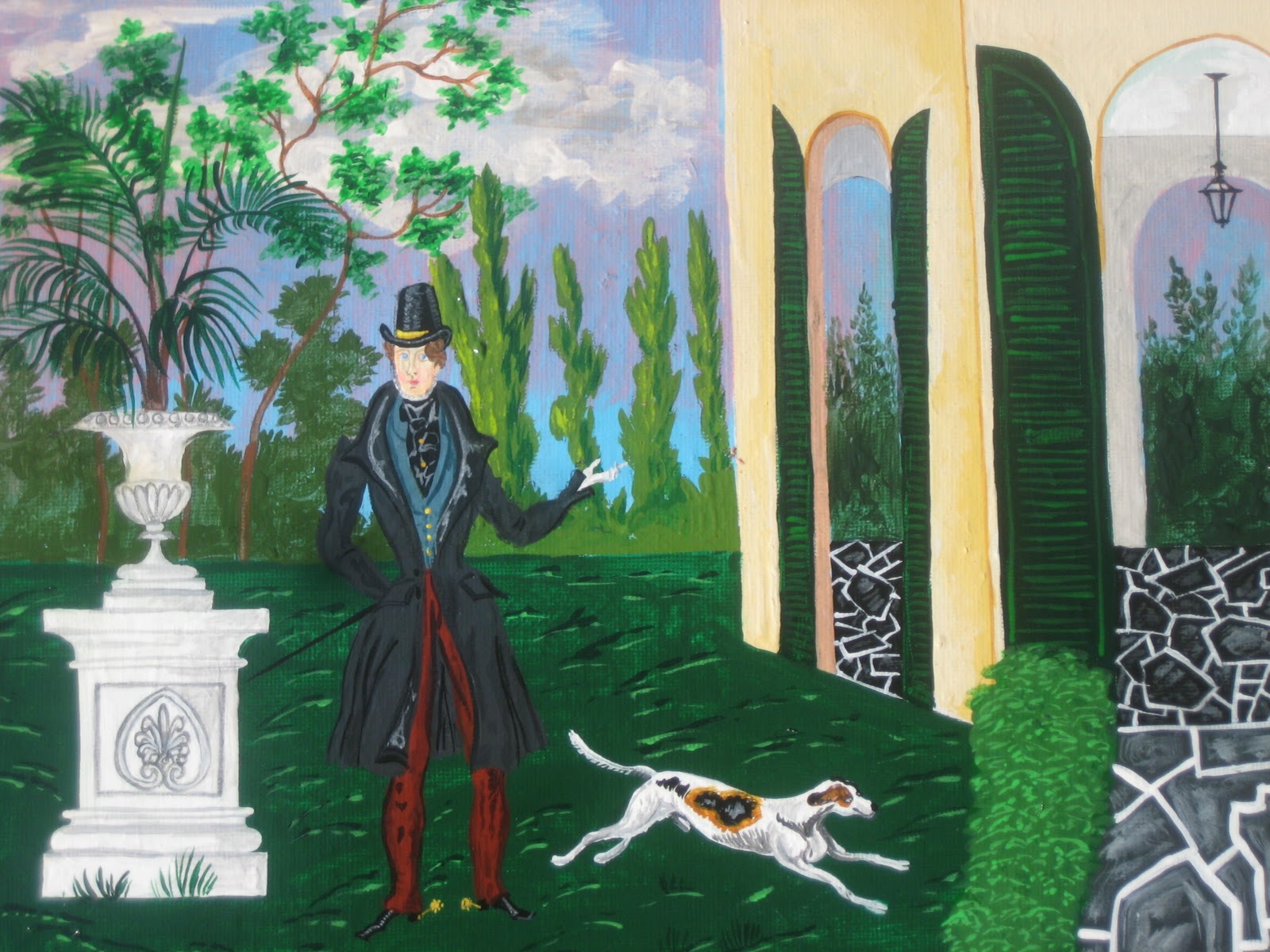
My latest masterpiece titled "Garçonnière" features a Antebellum French Vernacular architecture garçonnière a bachelor's apartment or quarters. In the French Creole South when boys in the house became teenagers they were moved out of the main home into separate quarters on the property so they could entertain and come and go without disturbing the main house ( mostly the female ocupants). This garçonnière is inspired by one at Houmas House Plantation and Gardens located in Louisiana.

My painting of a garçonnière is inspired by one at Houmas House Plantation and Gardens located in Louisiana


Around the garçonnière we have a French Creole teenage garçon fashionably dressed in a period of the 1830's gesturing to his home. His dog runs past him after a riding party on the other side of the garçonnière. The garçon stands by a classical stucco pedestal with Greek Palmetto/honeysuckle motif with a cast iron Medici style urn with ferns on top, typical garden ornaments of the Romantic period.

A French Creole teenage garçon fashionably dressed in the period of the 1830's gesturing to his home. His dog runs past him after a riding party on the other side of the garçonnière.


A riding party on the other side of the garçonnière.


"Garçonnière" framed and at the Art Gallery


Another painting I finished is a painting of a Angel titled "Mobile Angel of Abundance". Showing a Angel is flowing robe holding a golden shell of Abundance. She is in a colorful sky.

"Mobile Angel of Abundance"


My paintings at the Gallery

Friday, December 10, 2010

Latest artwork delivered to the Gallery today

Latest artwork delivered to the Gallery today

Mobile Free boy of color

Tonight is the Christmas Artwalk here in Mobile, Alabama, All of the Art Gallery's downtown are open late tonight. I was suppose to finish 7 paintings by today but only finished 3 oh well. I was happy to find out while I was installing my painting at the Gallery that I had sold one titled " Mobile Free boy of color" I have a early blog about him. The three new paintings from the top down "Greek Revival Gentleman", "18th century New Orleans", and "Alabama Camellia Belle.

Greek Revival Gentleman


Detail of Greek Revival Gentleman

"Greek Revival Gentleman", shows a dapper Free man of color standing outside of a Greek Revival town house from the 1840's period. He is fashionably dress with Top hat and stick. The lavender stucco Town house sits on a brownstone foundation with oval cast iron air vents. The Quincy granite steps sports classical cast iron urns with nicely manicured kumquat topiaries.  The deeply set panel Greek Revival doorway has decorative anthemion details on the top.


18th century New Orleans

18th century New Orleans

"18th century New Orleans", depicts a New Orleans Creole aristocrat from the period of French Queen Marie Antoinette standing on her French Quarter balcony holding a exotic parrot. She is dressed in a style fashionable of the 1780's. A mid-night blue satin dress with turban head dress sporting a feather. She is holding on to a Baroque style wrought iron balcony fashionable in New Orleans with Spanish iron smiths in the late 18th century. The decorative stucco building features classical pilasters and door surrounds. On the balcony is a potted orange tree a symbol of wealth.

Alabama Camellia Belle

Detail of Alabama Camellia Belle

"Alabama Camellia Belle" Shows a Alabama Belle in a Romantic Garden with two large Old World style Terracotta Pots with white & red stripe Camellia bushes. The Camellia flower is the state flower of Alabama. The Southern Belle has a ball gown of the 1840's period covered in red Camellias. She is standing on flagstone payment under a Classical Greek Revival wrought iron arbor.   

Monday, September 13, 2010

Greek Revival Dandies!!!

Greek Revival Dandy # 1

Sorry for the time I have been away. I have been so busy. I got into a Co-op Art Gallery. We had a grand opening last Friday. I have been busy down to the last min working on art and my space in the Gallery. Hopefully I can get part 3 of Hurricane Katrina out this week. I'm working on a series of paintings called "Greek Revival dandies" Here are one and two of a twenty part series. In each painting I show a fashionably dress young beau's in front of a Neoclassical Federal or Greek Revival doorway.


Greek Revival Dandy # 2
                                                                                    

Thursday, September 2, 2010

Fried green tomatoes, a Alabama delicacy!

Fried green tomatoes: Styling by Andrew LaMae Hopkins from his collection. hand block French wallpaper sample from the 1950's copying a early 19th century French classical design. Old Paris porcelain luncheon plates and dinner plates in the troubadour style made by Jacob Petit circa 1830's. 1840's Old Paris porcelain platter. American late 19th century serving fork. Early 19th century English cut glass Georgian decanter. Early 19th century French Empire glass from my Family. French linen monogram napkin mid 19th century from French boyfriends family. 1850's Southern coin silver fork made by A, Kapp from the Bruin family of Spring Hill, Mobile, Al. Ivory handed knife made in Toulon, France by Henfsling from French boyfriends family circa 1820's.


                      As the Summer ends I enjoy the last few dishes of fried green tomatoes fresh from my garden. A Southern delicacy made famous by a hit movie and novel by the same name. I have to say that since I have been back in Alabama I eat this dish once or twice a week. It is easy to make. Here is my recipe for this delicious simple Southern fare! Here in Alabama I was thought how to cook without measuring so I have tried to measure out amounts for you.


Andrews Fried Green Tomatoes Recipe


3 medium, firm green tomatoes

I half cup of seasoned Italian bread crumbs

1/4 cup of butter milk

2 beaten eggs

1/2 teaspoon salt

1/4 teaspoon pepper

Cooking oil


1: Cut unpeeled tomatoes into 1/4 inch slices. Whisk butter milk and eggs together and session with salt and pepper. Meanwhile, place bread crumbs, milk/ eggs mixture, and sliced tomatoes in separate shallow dishes.


2: Heat 2 inches of cooking oil in a fry baby or large cast iron skillet to 350'. Dip tomato slices with a fork in milk/eggs mixture, then bread crumbs on both sides. In the skillet, fry 3 or 4 of the coated tomato slices at a time, for 2-3 minutes on each side or until brown. The slices should float up to the top. As you cook the rest of the tomatoes. Place on paper towel to drain oil. Season to taste with salt and pepper and serve. Now you can say bon appetit in a Alabama accent.


Cut unpeeled tomatoes into 1/4 inch slices.


Whisk butter milk and eggs together and session with salt and pepper.


place bread crumbs in a shallow dish


Using a fork dip tomato slices in mike/egg mixture


Then coat in bread crumbs


Place into hot oil they should float up right away.


Flip and make sure both sides turn golden brown


Place on paper towel to drain oil.


Season to taste with salt and pepper and serve.

In New Orleans this Southern dish is made Creole by serving with a remoulade sauce, but I like them without and just a glass of Harveys Bristol Cream sherry


Now say bon appetit! in a Alabama accent and enjoy!


Saturday, August 28, 2010

Anything Cool! Keeping cool in the Antebellum South, Part two

Chilled desserts that were popular during the 19th century


We take cold drinks and cool food for granted today. But during the first half of the 19th century anything cool or cold during the Summer months in the South was a luxury item. Chilled fruit after dinner, puddings and cool Gelatin desserts considered cheep today were very popular and considered a special treat in the 19th century. Gelatin desserts were made from calf's foot jelly. This was made by extracting and purifying gelatin from the foot of a calf; this gelatin was then sweetened and flavored with fruit juice and additional sugar, if necessary. A very laborious possess as compared to how easy making jello is today.


English Regency mahogany Cellarette used for chilling wine


A red glass wine glass rinser, would be place in front of dinner plate. Wine rinsers or wine washers were used to cool or rinse wine glasses between courses of meals.


Paris porcelain monteith 18th c, a wine-glass cooler or rinsing bowl with a notched or crenellated rim designed to hold the feet of the glasses while their bowls are suspended in the iced water which it contains


Drink like wine had to be chilled before being served in metal lined Cellarets or Wine coolers sometimes made of Porcelain or Tole. Also during this period wine glasses were chilled in monteiths a vessel with notched rims used to cool drinking glasses. Fruit was cooled in porcelain fruit coolers. The lid was bowl shaped so ice could be packed on the top as well as inside the fruit cooler. Ice cream was also served out of fruit coolers.

Late 18th century Paris porcelain Fruit/ice cream cooler by Nast Cornflower pattern


Pair of Paris porcelain Fruit/ice cream cooler with trompe l'oeil fruit


Detail Fruit/ice cream cooler with handle in the allegory of Winter


Detail Fruit/ice cream cooler with handle in the allegory of Winter


Cold fruit soups were popular in the South during the Summer months. The ice creams we enjoy today are said to have been invented in Italy during the 17th century. They spread northward through Europe via France. "French-style" ice cream (made with egg yolks) and its American counterpart, "Philadelphia-style," are (no eggs, or egg whites only) enriched products made with the finest ingredients. Vanilla is the most popular flavor of this genre.

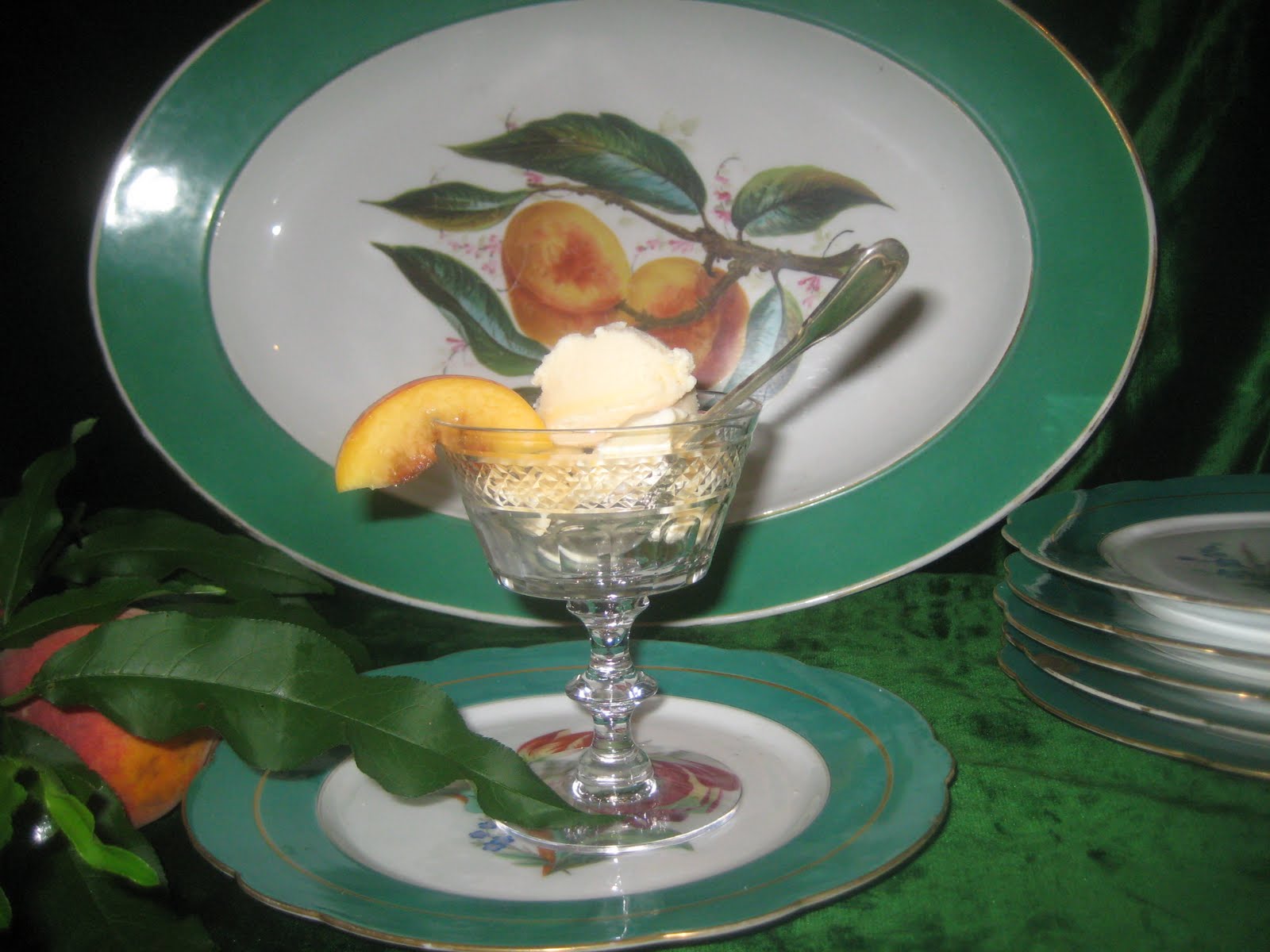
Peach ice cream Old Paris porcelain, cut glass and silver from my collection


Peach ice cream Old Paris porcelain, cut glass and silver from my collection
                                                                                    

During the first half of the 19th century ice cream was made at home or could be had in fashionable Coffee houses offering the cold treat. Most large city's in America had coffee houses offering ice cream starting in New York city around the 1820's. In Mobile, Alabama we had Festorazzi's Coffee Saloon opened in 1854 on the corner of Dauphin and St. Emanuel streets. Sylvester Festorazzi was born at Regolo, near Lake Como, in 1819. He became a confectioner, and worked at the trade first in Milan, then in Marseille. In 1850, he came to New Orleans where he went into the confectionery business. and opened Festorazzi's Coffee Saloon in Mobile. Coffee houses of the period did not offer hot food. The only thing served hot was tea and coffee. Cold deserts, pastries & swndwiches were served. Here is a ad from the Coffee saloon dating from the early years of the war between the states.

MOBILE REGISTER AND ADVERTISER, September 29, 1861, p. 4, c. 4


Ice Cream Saloon and Verandah,

Cor. Dauphin and St. Emanuel Sts.

Opposite Public Square


The undersigned have the honor to announce to their friends and the public in general that they have re-opened their well known and popular Saloon, up stairs, where they are prepared to serve their customers with the choicest kind of

Ice Creams

Sherberts, [sic]

Biscuits Glaces,

Cakes and

Confections

of every description.

Parties, Weddings, Dinners, &c., will be furnished at short notice and in the best style.

We have all kinds of Cakes and Confectioneries always on hand, fresh and of the best quality, which we will sell at reasonable prices.

S. Festorazzi & Co.

N.B.—Orders for the country will be carefully attended to.


Paris Coffee House 1819


Before the development of modern refrigeration, ice cream was a luxury reserved for special occasions. Making it was quite laborious; ice was cut from lakes and ponds during the winter and stored in holes in the ground, or in wood-frame or brick ice houses, insulated by straw and saw-dust. Many Southern farmers and plantation owners, including U.S. Presidents George Washington and Thomas Jefferson, cut and stored ice in the winter for use in the summer. Ice cream was made by hand in a large bowl placed inside a tub filled with ice and salt. This was called the pot-freezer method.


During this period all food had to be bought, cooked and consumed the same day with out refrigeration. People lucky to have ice houses or dairy buildings could store perishable food longer.


Wealthy land owners built Ice houses on there property to store large blocks of ice shipped down from the East Coast. Most ice houses were built under ground. During the winter, ice would be taken into the ice house and packed with insulation, often straw or sawdust. It would remain frozen for many months, often until the following winter, and could be used as a source of ice during summer months. The main application of the ice was the storage of perishable foods, but it could also be used simply to cool drinks like mint juleps or allow ice-cream and sorbet desserts to be prepared.

Temple/Ice house, Montpelier 1810-1811
                                                                                

James Madison built the Temple/Ice House on his property Montpelier between 1810-1811. The Neoclassical style Greek Temple was designed in 1802 by William Thornton, architect of the nation's Capitol, but was not built until 1810-1811. Thomas Jefferson, Madison's good friend and colleague, suggested two carpenters James Dinsmore and John Neilson, both had did work for Thomas Jefferson. Below the concrete base of the Classical Temple is the Ice House which is brick lined shaft, 24 feet deep and 16 feet in diameter.


The Temple served two purposes, aesthetic beautifying the functional. The Temple could be use on Summer days as a place to have a light meals with cool breeze flowing as well as being cooled from beneath. The Ice House two stores below, provided the Madison's with cool drinks like mint juleps and ice cream all summer long, a luxury during the first half of the 19th century.

Rosedown Plantation Gazebo - St. Francisville, LA
                                                                                  

Wealthy Southerners built garden follies like Summer houses, a one room building in a garden used for tea or light supper or entertaining during the summer months. Because Summer homes were one room buildings in a garden. Cool air could circulate around the building thru windows and doors. Making them a lot cooler then rooms for entertainment in the big house. Please see my blog "The Derby-Beebe Summer House 1799".

99The Derby-Beebe Summer House 1799


Spring House, Baltimore, MD by Benjamin Henry Latrobe built over a spring and used to keep dairy products cool

                                                                                  
You could only have something cool or cold to eat during the Summer if you have money to buy iced shipped down from the East Coast and a dark insolated place to store the ice. Ice was cut from natural lakes up North. During the first half of the 19th century, ice harvesting became big business in America. Large numbers of horses were used to harvest the ice and their waste led to pollution of ice the water and the shoreline.
Statue of John Gorrie, 1914, by C. Adrian Pillars


In 1842, Southern physician, John Gorrie, living in Apalachicola, Florida, a port city on the Gulf coast designed the first system for refrigerating water to produce ice. He also conceived the idea of using his refrigeration system to cool the air for comfort in homes and hospitals (i.e., air-conditioning). Southerners could have had man made clean ice and air-conditioning in the 1840's and 50's. His system compressed air, then partially cooled the hot compressed air with water before allowing it to expand while doing part of the work required to drive the air compressor. That isentropic expansion cooled the air to a temperature low enough to freeze water and produce ice, or to flow "through a pipe for effecting refrigeration otherwise" as stated in his patent granted by the U.S. Patent Office in 1851. Gorrie built a working prototype, but his system was a commercial failure. Gorrie sought to raise money to manufacture his machine, but the venture failed when his partner died. Humiliated by criticism, financially ruined, and his health broken, Gorrie died in seclusion on June 29, 1855.

Schematic of Gorrie's ice machine
                                                                                   

The ice factory industry was actually propelled by Southern States, who were tired of relying on The North for lake ice that was sometimes polluted . Many entrepreneurs started investing money in formulating mechanical refrigeration at an economical cost. In New Orleans, a very important event in ice history occurred. The Louisiana Ice Manufacturing Company opened in 1868 making man made ice and offering a product that cost significantly less than natural ice.


Today we keep cool by taking cool showers and baths during the Summer. Most homes in the South did not have a bathroom as we do in homes today. During the antebellum period in the South. Before indoor plumbing, bathtubs—like chamber pots and washbowls—were moveable accessories: large but relatively light containers that bathers pulled out of storage for temporary use in a bedroom. The typical mid-19th-century bathtub was a product of the tinsmith's craft, a shell of sheet copper or zinc. In progressive houses equipped with early water-heating devices, a large bathtub might be site-made of sheet lead and anchored in a coffin-like wooden box. Bathtubs were lined with linen cloth.

19th century Tin bathtub


Galvanized tin hip bath


Tin bathtub in coffin-like wooden box
                                                                                

The average person in the Antebellum South only tuck a bath once a month. As doctors of the period thought that frequent bathing removed body oils, doctors thought this bad for skin. People did wish almost daily parts of the body that were visible to the public; for example, the ears, hands, feet, and face and neck. Taking a bath was a considerable labor of drawing, carrying, and heating water, filling the bath and then afterward emptying it. Bath water was shared by all the immediate family members from the oldest member of the family to the youngest. Precedence in bath order could lead to contention since the first user enjoyed the cleanest and warmest water. If you were traveling or did not have a bathtub at home you could always go to a bath house.

WOMAN TAKING A FOOTBATH 1766 by FRANÇOIS BOUCHER


Old Paris porcelain footbath
                                                                            

Most large city's in the South had public bath houses. Here is a ad for one in Mobile, AL


Mobile Bath House.


Entrance on Conti, between Royal & St. Emanuel.

Entrance No. 0 South Royal Street.

The proprietor takes pleasure in announcing to the public that the above Establishment is now in complete order having been nicely Painted and furnished with new Bathing Tubs throughout. He will always be prepared to accommodate his patrons with comfortable Warm, Cold and Shower Baths, at all hours from 5 A.M. til 10 P.M.

A Barber Shop is also added. In short, a gentleman will have here every facility to Bathe, Dress and be attended to in every respect. Young.


What we can easily eat, drink or do to stay cool today was sometimes a challenge to achieve. It depended on how much money you had and tuck a lot longer to have during the Antebellum period in the South. As two storms are headed for the Gulf Coast today five years after Hurricane Katrina, it reminds me of going thru Katrina in the French Quarter and trying to stay cool in New Orleans for over a week after the hurricane during one of the hottest times in New Orleans was almost like living in the South 160 years ago. Tomorrow I will post my story of surviving Katrina during the Hurricane and the week after in New Orleans.