The Salon Doré, West Wall
The Salon Doré a magnificent early Neoclassical period gilded room now hosed in the Corcoran Gallery of Art in Washington D C is one of my favorite period 18th century French rooms in America. I saw this room first in 1999 right after it was restored and last in Aug of 2007 when I was in D. C. for two weeks for my birthday. The Salon Doré was commissioned by Pierre Gaspard Marie Grimaud d'Orsay (14 December 1748 - 3 January 1809, Vienna), comte d'Orsay, was a Great collector of sculptures, Old Master paintings and drawings (which most of his collection now in the Louvre).
Research has shown that while it was clear that the original cornice and ceiling mural remained in Paris, other minor elements also remained in place at the hôtel de Clermont – with plaster copies being sent to the United States. For instance, the medallions above the doors were originally carved from wood – but the Corcoran medallions are plaster replicas.
The amazing flower paintings that decorate the door panels are of bouquets of cut flowers that are represented in a naturalistic fashion tied with a ribbon on the upper doors and in Neoclassical urns on the bottom doors.
The amazing flower paintings that decorate the door panels are of bouquets of cut flowers that are represented in a naturalistic fashion tied with a ribbon on the upper doors and in Neoclassical urns on the bottom doors.
He acquired in 1768 the hotel de Saissac (now hotel de Clermont), 69 rue de Varenne, Paris. This had been built for Jeanne Therese Pelagie d'Albert de Luynes, marquise de Saissac, in 1708, and Pierre had it rebuilt by Pierre Convers, Jean Augustin Renard et Charles Joaquim Benard, with the old ground floor bedroom made into The Salon Doré, Construction of the Salon Doré began in early 1770 was finished in late 1770, just in time for the comte’s wedding. Its early neoclassical style marked a return to the order of classical antiquity – with gold leaf Corinthian pilasters that framed gilded carved trophies set in boiserie (intricately carved wood paneling). Enormous mirrors made of four sections of glass with floral garlands, interlacing ribbons,, which alternate with the pilasters and are set in frames with rectangular corners. Antique style medallions above the doors held up by putti (cupids), where vestal virgins tend the flame of Love or make sacrifices to it, rich cornices, and in general, symmetry and a formal clarity. The rather elaborate ceiling mural – an allegorical depiction of the arts and the four seasons was originally in the next room the dinning room of the house. The ceiling of the salon was decorated with L'Apotheose de Psyche on canvas by French artist Hugues Taraval. Unfortunately this ceiling did not follow the paneling to the United States. It was moved to the Hotel Veil-Picard and was eventually destroyed during the demolition of that building in 1970.

The Louis XVI style Fireplace with mantel is made of Marble from Senator Clarks Maryland quarry and dates to the early 20th century. It has beautiful Neoclassical Parisian gilt-bronze ormolu mounts.
Clock of the Vestals Carrying the Sacred Fire 1789 by Pierre-Philippe Thomire gilded, patinated, and painted bronze, Sevrès porcelain, enamel on copper, and marble belonging to French Queen Marie Antoinette
The Clock of the Vestals marked the passing of the hours in Queen Marie-Antoinette’s boudoir, or private sitting room, in the Tuileries Palace in Paris, adjacent to the Palais du Louvre. The royal family was forced to move there in October 1789 after a mob of Parisians attacked the palace at Versailles, the official residence of the king for more than a hundred years. In the Tuileries the king and queen held court in gilded splendor, but they were state prisoners nonetheless. Their last unhappy days together were passed in this palace, before they were permanently separated in the mean quarters where they awaited their executions in 1793
Clock of the Vestals Carrying the Sacred Fire 1789 by Pierre-Philippe Thomire gilded, patinated, and painted bronze, Sevrès porcelain, enamel on copper, and marble belonging to French Queen Marie Antoinette
Clock of the Vestals Carrying the Sacred Fire 1789 by Pierre-Philippe Thomire gilded, patinated, and painted bronze, Sevrès porcelain, enamel on copper, and marble belonging to French Queen Marie Antoinette
Neoclassical gilt-bronze ormolu andirons date from circa 1770-75. Each has a classical goat head altar at the top and the head of Medusa on the base.
Built for the occasion of the wedding, the decor of the room was meant to be a symbol of marital unity, and of military virtue – hence the floral garlands, putti, and trophy panels depicting motifs such as love and victory. As part of the decoration, certain chairs upholstered with Gobelins tapestries woven with bouquets of flowers on a red crimson background, and console tables with tops of Antique veined alabaster were specifically designed to be placed against the walls. This type of architectural furniture was considered to be an extension of the decorative paneling, and was not meant for use.
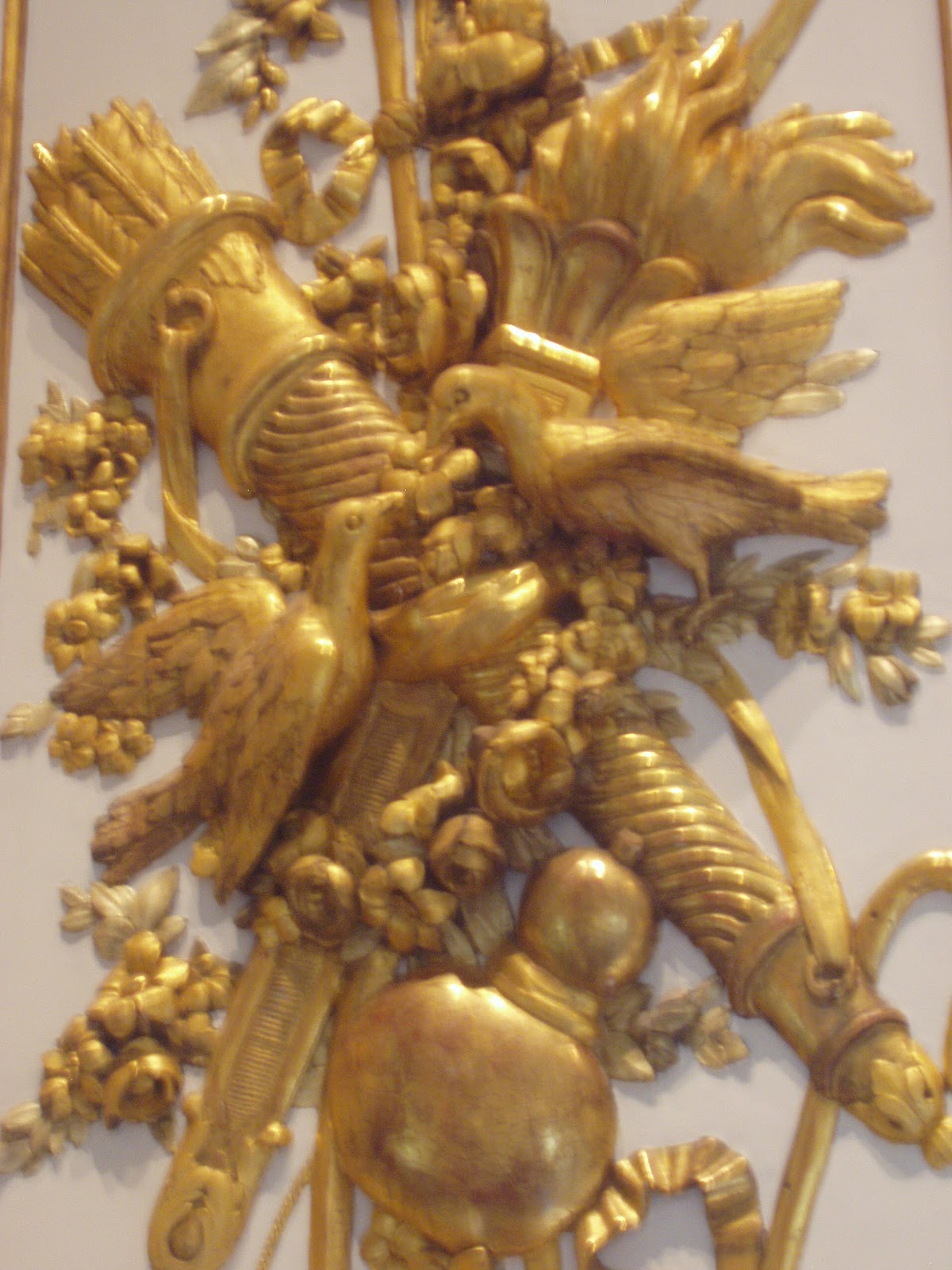
Victory trophy panel
When looking at the gold leaf closely you will see that two kinds of gold leaf was used to originally gild the 18th century room. A bright yellow gold and, for the highlights, a "green gold" that derives it's color from it's silver content were utilized in the Salon Doré. The final step of the process of gilding, details were highlighted by burnishing the gold with an agate stone.
Other furniture was designed to be used, and arranged within the space – including console tables, a rolltop desk, a card table, a sofa, six fauteuils (armchairs), eight chaises à la reine (flat-back chairs), and four bergères (upholstered armchairs). These chairs were simpler than the architectural ones, in that their frames were uncarved – however, as a sign of wealth, gilding was added.
This Renovation constituted an important step in the evolution of the new Neoclassical taste, and contributed to his entry into aristocratic circles of the Faubourg Saint-Germain.
He married Marie Louise Amélie de Croÿ (1748-1772), princesse de Croÿ-Molembais, daughter of Prince Guillaume François de Croÿ et Princess Anne Françoise Amélie de Trazegnies, on December 31, 1770. Earlier in 1770 Pierre Gaspard had been raised to the title of comte by Louis XV.
Marie-Louise and Pierre had one child, Albert-Jean-François-Louis-Marie Grimaud (June 15 1772-1843). (Albert was later called "the beau d'Orsay", and was in turn father of the dandy Alfred Guillaume Gabriel, Count d'Orsay.) Marie Louise died giving birth to him, and Pierre (a patron of the arts like his father) began traveling Europe for consolation, gathering famous collections of Old Master paintings and Antique sculptures. On his travels he also found a new wife, Marie Anne de Hohenlohe-Waldenburg-Bartenstein, of the house of Hohenlohe-Waldenburg-Battenstein, whom he married on August 22, 1784. The couple moved to Germany in 1787, meaning that - on the outbreak of the French Revolution two years later - Gaspard's property in France was seized, he was declared an Émigré, and they were left in the poverty in which he died.

The original window curtains are describe in a Inventory drawn up after the death of Marie Louise the comte's wife. They are Two window curtains made of four pieces of crimson damask with the whole being adorned with a band of imitation gold and estimated all together at eight hundred livres. The red background of the Gobelins tapestry on the gilded furniture would have matched the great curtains of crimson damask and given the salon it's dominant colors of crimson and gold, colors that were used for the decoration of the Royal apartments. Today the curtains are reproduced from a 1781 drawing of a window wall by the same architect Chalgrin. They are the perfect crimson, champagne and cream silks with golden passementerie all hand woven and hand made in France.

More than a century later, an American millionaire, Senator William Andrews Clark, purchased the Salon Doré, and had it installed in his nine-story Fifth Avenue mansion, that in 1908, the New York Times called “New York’s Most Expensive Private Mansion”. Having traveled extensively to Europe, Senator Clark grew particularly fond of France, and wanted the Fifth Avenue home that he was constructing to be a “French palace”. Because the square room was reconfigured to fit a rectangular space, the existing elements had to be rearranged, and new elements added – including 2 windows, a glass paned duble door, 4 pilasters, and two additional carved and gilt trophy panels (Theatre and Sports) all dateing from the early 20th century mixed into the 18th century elements.

For reasons unknown The original cornice and ceiling mural remained in Paris, other minor elements also remained in place at the Hôtel de Clermont – including the carved wood Capitals for all of the pilasters with plaster copies being sent to the United States.
With the inclusion of European period rooms being a popular affectation for the wealthiest of American residences. This type of business flourished around the turn of the century. Although some of the first documented 18th century Boiserie to cross the Atlantic to America was brought over by Boston collector Peter Parker. He acquired eight ornately carved and gilded Neoclassical Boiserie panels from the circular salon of the Hôtel de Montmorency in Paris in 1848. Shortly after the Hôtel de Montmorency was demolished. Mr Parker built a mansion called Deacon house incorporating the 18th century boiserie. See a earlier blog post titled "18th century Boiserie/paneling at the Boston Museum of Art".
Carved and gilded boiserie ( wood Paneling) has always been perceived as being movable since the carved panels were originally created in workshops and then transported to their intended destinations. Dismantling interior decoration was therefore not an unusual practice in France.
Sports trophy panel made for Senator Clark early 20th century
When looking at the gold leaf closely you will see that two kinds of gold leaf was used to originally gild the 18th century room. A bright yellow gold and, for the highlights, a "green gold" that derives it's color from it's silver content were utilized in the Salon Doré. The final step of the process of gilding, details were highlighted by burnishing the gold with an agate stone.
addition a new cornice and capitals were made from plaster – as the originals had remained in Paris, along with the original painted ceiling. For reasons unknown, Clark purchased a ceiling (painted on canvas) from an adjacent dining room of the hôtel de Clermont, and had it installed in the salon.
Huguette Marcelle Clark was the youngest daughter of former U.S. Senator and industrialist William A. Clark. was born in 1906 and recently died in May 24, 2011 two weeks short of her 105th birthday. living to be 104! Huguette Clark, made international news for her vast fortune, and extremely reclusive ways. The last known photograph of her was taken in 1930. Clark's will was filed on June 22, 2011 in Surrogate's Court. The last will and testament was made in 2005 and left 75% of her estate, about $300 million, to charity. Her longtime nurse, Hadassah Peri, received about $30 million, her goddaughter, Wanda Styka, received about $12 million and the newly created Bellosguardo Foundation $8 million. Other employees who managed her residences received smaller sums. Her attorney and accountant each received $500,000. One of Claude Monet's 250 oil paintings inspired by Water Lilies (Nymphéas) in his Giverny flower garden was bequeathed to the Corcoran Museum of Art. She purchased the 1907 painting from Galerie Durand-Ruel in 1930.
element
Upon his death in 1925, the Senator’s vast collection of art, including the Salon Doré, was bequeathed to the Corcoran Gallery of Art. Clark’s will had named the nearby Metropolitan Museum of Art as primary benefactor – however board members of the museum passed on the bequest, feeling that they were unable to accommodate certain restrictions and stipulations. Three years later, the Clark wing of the Corcoran opened to the public
The Salon Doré, South Wall (Theatre Trophy Panel) made for Senator Clark early 20th century
The Salon Doré, South Wall (Theatre Trophy Panel)
The Salon Doré, South Wall (Theatre Trophy Panel)
Over the next seventy of so years, the condition of the room began to deteriorate – due to a lack of climate control, several misguided restoration attempts, and the fact that the windows were often left open, enabling dirt and other pollutants into the space. From 1989 to 1993, the Corcoran undertook a major renovation of the Salon Doré. Using 18th century techniques, and materials ranging from garlic to more than 30,000 sheets of gold leaf, a team of French artisans was able to remove more than two centuries of wear and tear, breathing new life into the lavish, 18th century neoclassical drawing room.
Detail of the Trophy panel depicting Love.
For reasons unknown The original cornice and ceiling mural remained in Paris, other minor elements also remained in place at the Hôtel de Clermont – including the carved wood Capitals for all of the pilasters with plaster copies being sent to the United States.
The Salon Doré, West Wall
Interestingly enough, the 19th century owners of the hôtel de Clermont, the Duchâtel family, went to considerable lengths (and expense) to have replicas of the Salon Doré paneling cast in plaster, and reinstalled in the room original room. It is unclear as to what may have motivated the sale of the originals, as the family was more than economically secure. Perhaps the initial intent was to sell the copies as well.
Trophy panel depicting Arts and Sciences
The original window curtains are describe in a Inventory drawn up after the death of Marie Louise the comte's wife. They are Two window curtains made of four pieces of crimson damask with the whole being adorned with a band of imitation gold and estimated all together at eight hundred livres. The red background of the Gobelins tapestry on the gilded furniture would have matched the great curtains of crimson damask and given the salon it's dominant colors of crimson and gold, colors that were used for the decoration of the Royal apartments. Today the curtains are reproduced from a 1781 drawing of a window wall by the same architect Chalgrin. They are the perfect crimson, champagne and cream silks with golden passementerie all hand woven and hand made in France.
The amazing flower paintings that decorate the door panels are of bouquets of cut flowers that are represented in a naturalistic fashion tied with a ribbon on the upper doors and in Neoclassical urns on the bottom doors.
The amazing flower paintings that decorate the door panels are of bouquets of cut flowers that are represented in a naturalistic fashion tied with a ribbon on the upper doors and in Neoclassical urns on the bottom doors.
The Salon Doré, West Wall
Research has shown that while it was clear that the original cornice and ceiling mural remained in Paris, other minor elements also remained in place at the hôtel de Clermont – with plaster copies being sent to the United States. For instance, the medallions above the doors were originally carved from wood – but the Corcoran medallions are plaster replicas.
The Louis XVI style Fireplace with mantel is made of Marble from Senator Clarks Maryland quarry and dates to the early 20th century. It has beautiful Neoclassical Parisian gilt-bronze ormolu mounts.
The original window curtains are describe in a Inventory drawn up after the death of Marie Louise the comte's wife. They are Two window curtains made of four pieces of crimson damask with the whole being adorned with a band of imitation gold and estimated all together at eight hundred livres. The red background of the Gobelins tapestry on the gilded furniture would have matched the great curtains of crimson damask and given the salon it's dominant colors of crimson and gold, colors that were used for the decoration of the Royal apartments. Today the curtains are reproduced from a 1781 drawing of a window wall by the same architect Chalgrin. They are the perfect crimson, champagne and cream silks with golden passementerie all hand woven and hand made in France.
The rather elaborate ceiling mural – an allegorical depiction of the arts and the four seasons was originally in the next room the dinning room of the house.
To day, the original hôtel de Clermont room functions as Government office space – as the residence is now owned by the French Government, housing offices for the French Parliament. What a wonderful building with so much history to have a office! If traveling to D.C., I highly recommend seeing of the finest 18th century French period rooms in America check out the Salon Doré and the Corcoran Gallery, – it’s such a fantastic example of the ostentatious luxury that once categorized interior decoration in Mid 18th century Europe
The rather elaborate ceiling mural – an allegorical depiction of the arts and the four seasons was originally in the next room the dinning room of the house.
The original window curtains are describe in a Inventory drawn up after the death of Marie Louise the comte's wife. They are Two window curtains made of four pieces of crimson damask with the whole being adorned with a band of imitation gold and estimated all together at eight hundred livres. The red background of the Gobelins tapestry on the gilded furniture would have matched the great curtains of crimson damask and given the salon it's dominant colors of crimson and gold, colors that were used for the decoration of the Royal apartments. Today the curtains are reproduced from a 1781 drawing of a window wall by the same architect Chalgrin. They are the perfect crimson, champagne and cream silks with golden passementerie all hand woven and hand made in France.






 Posts
Posts