Tuesday, June 14, 2016

Today's purchases

A period Empire Sèvres' porcelain Chalice cup with French blue ground with burnished gilt tooled decoration with a hunting scene circa 1804-1809. 

Over the last few weeks I have bought some amazing rare French porcelain. The rarest of the rare was won today on ebay a early 19th century signed in stencilled iron-red M. Imple]/ de Sevres. This mark dates the chalice to 1804-1809, made during the reign of Emperor Napoleon. The chalice is egg shape and shaped like a eggcup but it's size is a lot bigger then a egg as it stands 3.75 inches tall, 3.25 inches across at the mouth, making it a handleless cup or small chalice. Real Sèvres' porcelain is extremely rare. More fake Sèvres' porcelain was made then the real thing. Sèvres' porcelain was the most expansive porcelain money could buy during the 18th and first part of the 19th century when this cup was made. Only the richest people could afford it and used Sèvres' porcelain as a status symbol.

  The rare cup is painted in a delicate French blue and decorated in two tone burnished gold gilt that is tooled/etched with a hunting scene. The cup also has other NeoClassical decorations painted on it in gold. The interior of the cup is bright burnished gold. Held in the highest regard among monarchs, aristocracy, emperors, and cardinals, the beauty of Sevres porcelain is infinite and enduring as we can see in this cup. The factory began as a modest workshop in the royal chateau of Vincennes in 1740, established for the express purpose of improving the quality and production of French porcelain. The result, some of the most resplendent porcelain ever created. Throughout it’s long years it has reinforced and advanced the French reputation for producing some of the world's highest quality luxury goods for the wealthy and privileged.

After the French Revolution Sèvres porcelain regained its former glory under Napoleon Bonaparte, who assumed power in 1804. He promoted elaborately ornamented pieces in the classical style like this chalice. The Empire’s richly decorated, themed dinner sets, for example, were enjoyed by distinguished guests, visiting rulers, and Napoleon himself. These pieces typically feature florals, landscapes, or cameo portraits, framed by solid gold edging accented with stylized palm fronds, the ancient Greek symbol of victory.

The rare cup is painted in a delicate French blue and decorated in two tone burnished gold gilt that is tooled/etched with a hunting scene. 

The factory, which had been founded in the town of Vincennes in 1740 and then reestablished in larger quarters at Sèvres in 1756, became the preeminent porcelain manufacturer in Europe in the second half of the eighteenth century. Louis XV had been an early investor in the fledgling ceramic enterprise and became itssole owner in 1759. However, due to the upheavals of the French Revolution, its financial position at the beginning of the nineteenth century was extremely precarious. No longer a royal enterprise, the factory also had lost much of its clientele, and its funding reflected the ruinous state of the French economy.


The rare cup is painted in a delicate French blue and decorated in two tone burnished gold gilt that is tooled/etched with a hunting scene. The cup also has other NeoClassical decorations painted on it in gold. 

However, the appointment in 1800 of Alexandre Brongniart (1770–1847) as the administrator of the factory marked a profound shift in its fortunes. Trained as both an engineer and a scientist, Brongniart was both brilliant and immensely capable, and he brought all of his prodigious talents to the running of the troubled porcelain factory. He directed the Sèvres factory as administrator until his death in 1847, and during those five decades influenced every aspect of its organization and production. Much of the factory’s old, undecorated stock was immediately sold off, and new forms—largely in the fashionable, more severe Neoclassical style—were designed to replace out-of-date models. The composition for hard-paste porcelain was improved, and the production of soft paste, for which the factory had been famous in the previous century, was abandoned in 1804. New enamels colors were devised, and Brongniart oversaw the development of a new type of kiln that was both more efficient and cost-effective.

The rare cup is painted in a delicate French blue and decorated in two tone burnished gold gilt that is tooled/etched with a hunting scene. The cup also has other NeoClassical decorations painted on it in gold. 

Much of the factory’s output during Brongniart’s first decade reflected the prevailing Empire taste, which favored extensive gilding, rich border designs, and elaborate figural scenes. Backgrounds simulating marble or a variety of hardstones were employed with greater frequency. The new range of enamel colors developed under Brongniart made it easier to achieve these imitation surfaces, and it is thought that his interest in mineralogy provided the impetus for this type of decoration.

The interior of the cup is bright burnished gold.


Signed in stencilled iron-red M. Imple]/ de Sevres. This mark dates the chalice to 1804-1809, made during the reign of Emperor Napoleon.

For objects produced in sets, such as dinner, tea, and coffee services, and even garnitures of vases, Brongniart preferred decorative schemes that linked the objects in terms of subject matter as well as stylistically. Dinner services were given coherence by the use of an overall theme, in addition to shared border patterns and ground colors. One of the best examples of this can be found in the “Service des Départements,” which was conceived by Brongniart in 1824. Each of the plates in the service was decorated with a famous topographical view of the département (administrative unit) of France that it represented, and its border was painted with small cameo portraits of figures from the region, as well as symbols of the major arts, industries, and products of the area. This same type of thematic unity is found on a coffee service produced in 1836. All of the pieces of the service are decorated with scenes depicting the cultivation of cacao, from which chocolate is made, or various stages in the preparation of chocolate as a beverage. The compositions were conceived and executed by Jean-Charles Develly, a painter at Sèvres who was responsible for many of the most ambitious dinner services produced at the factory during Brongniart’s tenure.

Signed in stencilled iron-red M. Imple]/ de Sevres. This mark dates the chalice to 1804-1809, made during the reign of Emperor Napoleon.

The range of objects produced in the first half of the nineteenth century was enormous, as were the types of decoration that they employed. A recent exhibition catalogue devoted to Brongniart’s years at Sèvres indicates that ninety-two new designs for vases were introduced, as were eighty-nine different cup models, and the types of objects produced by the factory included every sort of form required by a dinner or dessert service, coffee and tea wares, decorative objects such as vases, and functional objects such as water jugs, basins, and toiletry articles. A new formrarely replaced an older one; the range of production simply increased.

A period Empire Sèvres' porcelain Chalice cup with French blue ground with burnished gilt tooled decoration with a hunting scene circa 1804-1809. 

It's all about fifty shades of purple at le château de Hopkins!

It's all about fifty shades of purple at le château de Hopkins! 

Monday, June 13, 2016

Today's purchases

A period Empire circa 1810 large Old Paris porcelain coffee pot handpainted with roaring lion 

Over the past week I have bought some wonderful 18th & 19th century Old Paris porcelain from ebay, to add to my ever growing collection. Including in these purchases is this fabulous large Period Empire NeoClassical coffee pot, handpainted with a roaring lion on one side "I'm a leo" and hyena on the other side. The rest of the classical coffee pot is decorated in the finest Empire decoration.  The gold gilt spout is in the shape of a sea horse with acanthus leaf motif. 


The handle of the coffee pot continues the decoration of acanthus leafs with a beautifully detailed bisque mask of a satyr at the top and a intricate design of a bisque Greek honeysuckle at the bottom. The classical inspirations for this porcelain coffee pot are along the lines of designs of Percier and Fontaine Napoleon's architects. The designs drew for inspiration on symbols and ornaments borrowed from the glorious ancient Greek and Roman empires. This coffee pot does have some damage that I will have repaired. It is a beautiful & rich workmanship of  this period of French history. 

Detail of handpainted roaring lion. 

The Empire style, French pronunciation: ​[ɑ̃.piːʁ],the second phase of Romanticism, is an early-nineteenth-century design movement in architecture, furniture, other decorative arts, and the visual arts that flourished between 1800 and 1815 during the Consulate and the First French Empire periods, although its life span lasted until the late 1830s (or more depending on each country). From France it spread into much of Europe and the United States.

The style originated in and takes its name from the rule of Napoleon I in the First French Empire, when it was intended to idealize Napoleon's leadership and the French state. The style corresponds in that intent to the Biedermeier style in the German-speaking lands, Federal style in the United States, and the Regency style in Britain. The previous style in France was called Louis XVI style.

A handpainted hyena on the other side. 

The style developed and elaborated the Directoire style of the immediately preceding period, which aimed at a simpler, but still elegant evocation of the virtues of the Ancient Roman Republic:

The stoic virtues of Republican Rome were upheld as standards not merely for the arts but also for political behaviour and private morality. Conventionels saw themselves as antique heroes. Children were named after Brutus, Solon and Lycurgus. The festivals of the Revolution were staged by David as antique rituals. Even the chairs in which the committee of Salut Publique sat were made on antique models devised by David. ...In fact Neo-classicism became fashionable.

Detail of hand painted hyena on the other side. 

The Empire style "turned to the florid opulence of Imperial Rome. The abstemious severity of Doric was replaced by Corinthian richness and splendour".

Two French architects, Charles Percier and Pierre Fontaine, were together the creators of the French Empire style. The two had studied in Rome and in the 1790s became leading furniture designers in Paris, where they received many commissions from Napoleon and other statesmen.

The gold gilt spout is in the shape of a sea horse with white bisque acanthus leaf motif. 

In the United Kingdom, Germany, and the United States, the Empire style was adapted to local conditions and gradually acquired further expression as the Egyptian Revival, Greek Revival, Biedermeier style, Regency style, and late-Federal style.


Detail of the handle of the coffee pot. 

The beautifully detailed bisque Greek honeysuckle at the bottom. 

After Napoleon lost power, the Empire style continued to be in favour for many decades, with minor adaptations. There was a revival of the style in the last half of the nineteenth century in France, again at the beginning of the twentieth century, and again in the 1980s.

The beautifully detailed bisque mask of a satyr at the top of the handle. 
This coffee pot does have some damage that I will have repaired. 

I own a large collection of Old Paris porcelain classical coffee cups and cans dating from 1790-1830 that could be used with this coffee pot like these half egg shape cups with  loop handle and beautiful mellow delicate hand painted gold gilt.  


I can't wait to serve Café au lait out of this coffee pot at le château de Hopkins.


Today's purchases

A set of 8 French Old Paris porcelain Napoleon lll period dessert plates, hand painted with fruit and flowers with gold gilt and platinum trim borders decorated by Victor Etienne & Fils of Paris, France, Circa 1850-1870. 


Over the past week I have bought some wonderful 18th & 19th century Old Paris porcelain from ebay, to add to my ever growing collection. Including in these purchases are a fabulous set of Napoleon lll period circa 1850-1870 fancy dessert bowls, each hand painted with fruit and flowers! The burgundy trimmed borders have gold gilt and platinum trim. Each bowl is signed on the back in iron red for the decorating firm of Frenchman Victor Etienne.


The porcelain plates were made in Limoges France.  After 1830 because of pollution The king of the French Louis Philippe band the manufactory of porcelain in the city of Paris. It had to be made outside of the city. After this period most porcelain was made in Limoges, France and painted/decorated in Paris. Like these beautiful bowls. I can't wait to get them and used them at my next dinner or lunch!

The address of this Paris decorating firm is 29 Rue de Paradis. The street is located in the west of 10th arrondissement of Paris ( district of Porte-Saint-Denis ), between the 95 of the Rue du Faubourg-Saint-Denis and the 64 of the Rue du Faubourg Poissonnière. In 1710 the area was called The Paradise formerly Les Prés of God Daughters was even the site of a garden belonging to the religious community of the Filles-Dieu .

in the 19th century this fashionable Street of Paradis was "the" street of the crystal and china and other earthenware due to the proximity of the Paris-Est station that allowed the transport of materials from the Lorraine particular.


About 1831 Baccarat , the Company of Saint Louis Crystal and two other glass, Choisy-le-Roi and Bercy, moved to this fashionable Parisian street, "Barbier, Launay et Cie" then "Launay Hautin and Co.", located at n o  30 or 30a or 32 of the rue de Paradis-Poissonnière, current street Paradis, distribution of their products.

1850, Baccarat and the Company of Saint Louis Crystal resume only local, which it remains today only the street facade, dated 1832.

The Company of Saint Louis Crystal Place is a deposit 3 as the Baccarat house that also installs a bronze workshop there.

Baccarat house there were 246 employees in 189 .

This building later became the Baccarat museum until 2003 and will host a time the Pinacoteca of Paris from 2003.

According to the historical landmark affixed by the city of Paris was in the xix th  century on the site a post house for "diligence in eastern France."

Each plate has different hand painted Trompe l'oeil fruits & flowers. A nice antique design rolls around the rim. Then there's a gold & platinum border on the edge. All hand painted.

The quality of the handpainted Trompe l'oeil fruit is amazing 


The decorator's mark of Victor Etienne & Fils

Friday, June 10, 2016

The dance of the night-blooming cereus.

The delicate night-blooming cereus in full bloom @ le château de Hopkins.

While having dinner with my good friend Peter last night at his Bourbon street home in the French Quarter. I asked him what was the flower he wanted to know if I had seen in a French Quarter courtyard at a party I attended last weekend. Peter replied come with me into the courtyard. He showed me this exotic flower hanging from the balcony of a 1820's building behind his main house. I have been in Peter's courtyard many times but never noticed this plant. He told me it was originally from South America and brought to Creole New Orleans in the 19th century. He invited me to pull the one I was looking at that was still close. It was around 10:30 at night! 

Peter told me they only bloom at night and only for a few hours, mostly when he is asleep. I pulled the funny looking blossom that was still closed and walked home to put it in water. I did not expect for it to open since it was plucked and as I stayed up late with things to do I noticed  it starting to open. The most wonderful intoxicating fragrance admitted from it. The opening of the beautiful flower before my eyes was one of the most amazing things I have seen in a long time. The wonders of nature. At the same time I was a little worried as in the back of my mind I could think of the movie "The Little Shop of Horrors"  and hear "Feed me! Seymour" I was up most of the night to see the wonderful transformation of this amazing flower! I awoke this morning to find a wilted bud. I consider myself very lucky. Few have ever seen this flower let alone experienced its intoxicating scent.


The delicate night-blooming cereus hanging from Peter's balcony 

The beautiful exotic night-blooming cereus! It is displayed in a 1830's Jacob Petit Old Paris porcelain perfume bottle made for a French aristocrat @ le château de Hopkins.

The next morning the beautiful dance of this flower is finish! 


A Greek Revival apt on Royal Street.

In the parlor a original  black Egyptian marble mantels in the Greek Key pattern. 

A few weekends ago I had the chance to view a amazing historical apt on Royal Street. Located on the 2th floor of a early 19th century Creole building, the house was remodeled in the classical Greek Revival style in 1835. A lot of the original details of this amazing house still remain in this large 1,990 sq ft apt. Lot's of original black Egyptian marble mantels, plaster ceiling medallions gasoliers and wrought iron balconies!  

This wonderful spiral staircase leads you up to the apt. 

Original storage closet under the staircase! 

A view looking up at the spiral staircase 


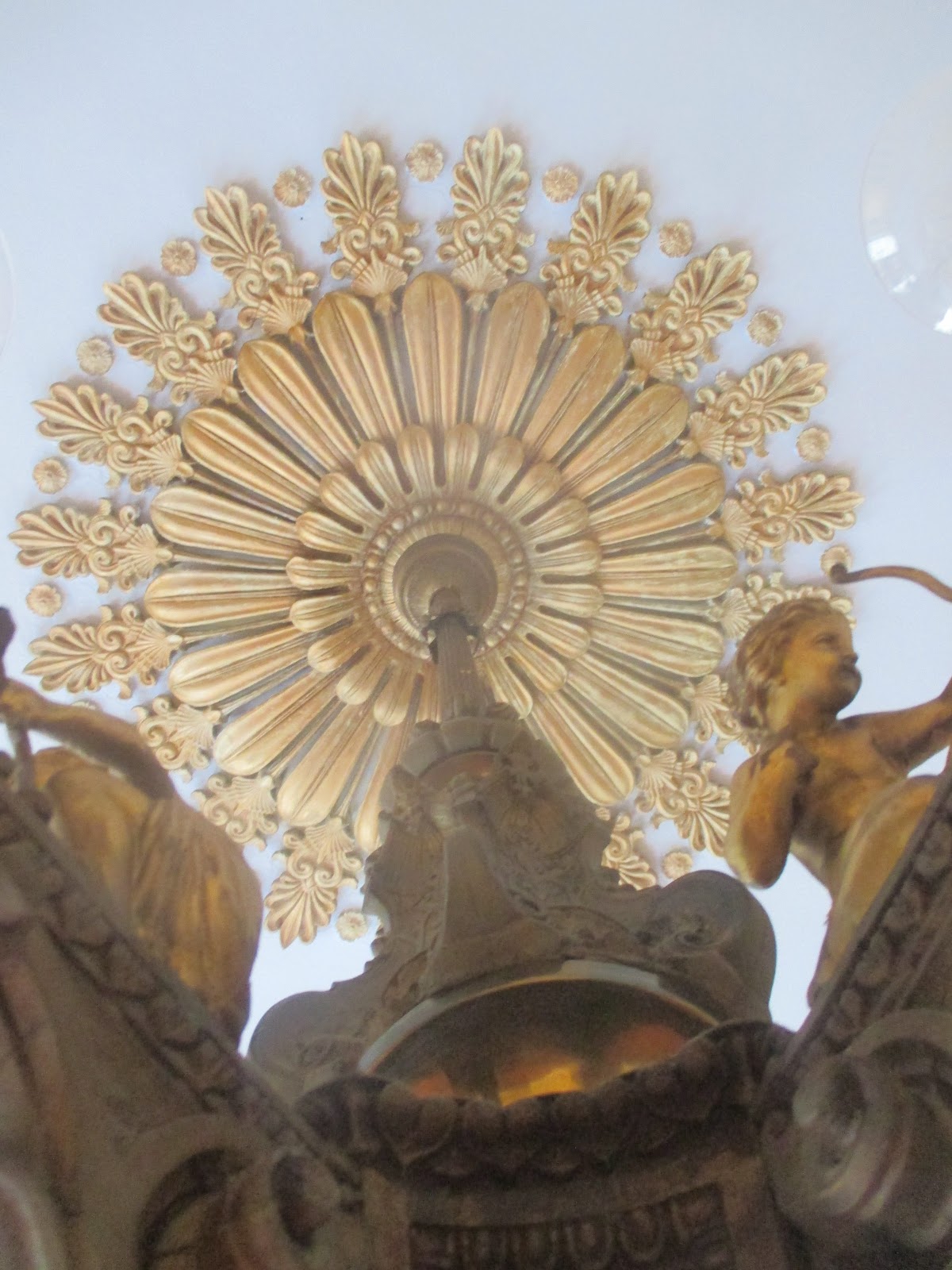
The parlor has a wonderful classical ceiling medallion out of American architect Minard Lefever Greek Revival design book. 


Hanging from the classical medallion is a Cornelius & Baker 6 Arm Allegorical gilt bronze gas Chandelier Circa 1850.


ceiling medallion out of American architect Minard Lefever Greek Revival design book. 


The large parlor 


A black Egyptian marble mantel in the kitchen. 

Detail of the black Egyptian marble mantel


Nice Greek Revival eared French door between the kitchen and parlor 


Looking into one of the bedrooms! 

Wonderful New Orleans wrought iron

Amazing views from the balcony. 


Amazing views from the balcony. 


Amazing views from the balcony. 


Amazing views from the balcony. 


Amazing views from the balcony. 


The courtyard!