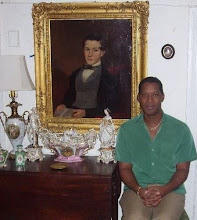
The latest addition to my home. A 1840's French Louis Philippe period gilt
wood frame turned into a mirror. In the Louis XIV/Regence style. The frame is
gold leafed with low relief acanthus strapwork with bellflowers and cartouches
with grotesque faces in the corners. `
Last weekend was the monthly estate sale that I attend every month. I
thought I was going to leave this sale empty handed except for a few 1960's
newspapers off of the dollar table. After my second time around the room
reexamining the thousands of displayed items. I noticed behind a Mid-Century
modern glass console a large ornate gold framed mirror almost hidden. At first I
thought it was one of the many gold toned composition reproduction frames you
see now a days. Upon closer inspection I realized it was a very fine period 19th
century gold leafed frame. French Louis Philippe period around 1840. But in
the Louis XIV/Régence style.
If this frame was English or American it would termed as Early Victorian
but French antiques and decorative arts are names after the king during the time
it was made. Louis Philippe - 1830 to 1850, the citizen king or king of the
French. Charles X was overthrown in 1830 and Louis Philippe, Duke of Orleans,
became France's new leader. He managed both royalists to his right and radicals
to the left, while sympathizing with the bourgeois class. The 19th century was a
period of reviving older Antique styles and making them up-to-date for modern
19th century living.
Most of the original gold leaf was intact and in good condition on the
frame. The frame was in good condition except a decorative face was missing from
a lower corner cartouche. Nothing too major of you know how to cast and replace
them. Plus I loved the price. Priced at $45.00 it was a bargain. Although the
Frame had a mirror in it I think it originally held a painting. Picking the
frame up, it was very heavy weighting over 100 pounds. I already had a spot for
it in my home. Over my 1840's Alabama made sideboard.
It has been some time since I have been very pleased with a antique
purchase. I now walk into my Dinning room a few times a day just to look at my
new find. I'm very pleased with this mirror. I love the color of the original gold leaf . The low relief strapwork design and grotesque faces on the cartouches.
If you look round the ornate raised patterns on the frame you will see a small
repeat hexagonal honeycomb pattern. This design was made by placing a gauze-like
cotton Cheesecloth over the wood frame and painting over it with gesso. Then the
ornate composition decoration is applied and the whole frame is gold leaf.
You can see the hexagonal honeycomb pattern a little bit better here.
I love the corner cartouches with grotesque faces.
The repeat pattern of the frame is made up of elaborate acanthus
"Strapwork" In the history of art and design, the term strapwork refers to a
stylised representation in ornament of strips or bands of curling leather,
parchment or metal cut into elaborate shapes, with piercings and often
interwoven. Strapwork is a frequent element of grotesques -- arabesque or
candelabra figures filled with fantastical creatures, garlands and other
elements—which were a frequent decorative motif in 16th century Mannerism, and
revived in the 19th century and which may appear on walls—painted, in frescos,
carved in wood, or molded in plaster or stucco -- or in graphic work.
The term grotesque was long used largely interchangeably with arabesque and
moresque for types of decorative patterns using curving foliage
elements.
Since at least the 18th century (in French and German as well as
English) grotesque has come to be used as a general adjective for the strange,
fantastic, ugly, incongruous, unpleasant, or disgusting, and thus is often used
to describe weird shapes and distorted forms such as Halloween masks. In art,
performance, and literature, grotesque, however, may also refer to something
that simultaneously invokes in an audience a feeling of uncomfortable
bizarreness as well as empathic pity. More specifically, the grotesque forms on
Gothic buildings, when not used as drain-spouts, should not be called gargoyles,
but rather referred to simply as grotesques, or chimeras.

The first appearance of the word grottesche appears in a contract of 1502
for the Piccolomini Library attached to the duomo of Siena. They were introduced
by Raphael Sanzio and his team of decorative painters, who developed grottesche
into a complete system of ornament in the Loggias that are part of the series of
Raphael's Rooms in the Vatican Palace, Rome. "The decorations astonished and
charmed a generation of artists that was familiar with the grammar of the
classical orders but had not guessed till then that in their private houses the
Romans had often disregarded those rules and had adopted instead a more fanciful
and informal style that was all lightness, elegance and grace."
In these
grotesque decorations a tablet or candelabrum might provide a focus; frames were
extended into scrolls that formed part of the surrounding designs as a kind of
scaffold, as Peter Ward-Jackson noted. Light scrolling grotesques could be
ordered by confining them within the framing of a pilaster to give them more
structure. Giovanni da Udine took up the theme of grotesques in decorating the
Villa Madama, the most influential of the new Roman villas.
In the 16th century, such artistic license and irrationality was
controversial matter. Francisco de Holanda puts a defense in the mouth of
Michelangelo in his third dialogue of Da Pintura Antiga, 1548:
"this
insatiable desire of man sometimes prefers to an ordinary building, with its
pillars and doors, one falsely constructed in grotesque style, with pillars
formed of children growing out of stalks of flowers, with architraves and
cornices of branches of myrtle and doorways of reeds and other things, all
seeming impossible and contrary to reason, yet yet it may be really great work
if it is performed by a skillful artist."

Artists began to give the tiny faces of the figures in grotesque
decorations strange caricatured expressions, in a direct continuation of the
medieval traditions of the drolleries in the border decorations or initials in
illuminated manuscripts. From this the term began to be applied to larger
caricatures, such as those of Leonardo da Vinci, and the modern sense began to
develop. It is first recorded in English in 1646 from Sir Thomas Browne:"In
nature there are no grotesques". By extension backwards in time, the term became
also used for the medieval originals, and in modern terminology medieval
drolleries, half-human thumbnail vignettes drawn in the margins, and carved
figures on buildings (that are not also waterspouts, and so gargoyles) are also
called "grotesques".
A boom in the production of works of art in the
grotesque genre, characterized the period 1920-1933 of German art. In
contemporary illustration art, the "grotesque" figures, in the ordinary
conversational sense, commonly appear in the genre grotesque art, also known as
fantastic art.
The missing gesso grotesque face on the right hand lower corner is cleverly concealed
by a 1850's French Paris porcelain vase.
In front of the 1840's Louis Philippe frame is a 1830's Louis Philippe
troubadour style Paris porcelain tureen
Gilt brass girandole lamp on the sideboard.
Plus you can see the old mortise and tenon construction of the frame
Age old Mellowed Yellow ochre paint on the sides of the frame.


 Posts
Posts