My latest Masterpiece titled "Pierre de Pontalba surrounded by his ancestors at le château de Mont l'Évêque" by Andrew LaMar Hopkins, 8 x 10. Not for sale. In the collection of the Artist!
Showing posts with label Creole. Show all posts
Thursday, February 1, 2018
"Tonton de Blanc the Marie Antoinette of Louisiana" by Andrew LaMar Hopkins
My latest masterpiece is titled "Tonton de Blanc the Marie Antoinette of Louisiana" 11 x 14, Available. At a Christmas party I met a ancestor of the fabulous Tonton de Blanc who told me her fascinating story of this amazing lady. I thought at that time I needed to paint her. Tonton de Blanc was the Queen of beauty and fashion of late 18th century Saint Martinville, Louisiana. In my painting Tonton is standing in her Saint Martinville home holding a basket of fruit. The room is furnished with Louisiana made Creole furniture, like the Mahogany Cabriole Leg Armoire to the right and the Louisiana mahogany one drawer side table to the left. On the Creole table is a 18th century cobalt and ormolu Sèvres porcelain vase of garden flowers.
Over the table is a oil portrait French Queen Marie Antoinette by court painter Elisabeth Vigee-Lebrun. While in France Tonton de Blanc was in the Court of Marie Antoinette and Louis XVI. On top pf the armoire are wallpaper hat boxes. The French doors have a Toile de Jouy and lace drapery treatment. Tonton stands on a imported marble floors that includes yellow Royal Siena marble. Tonton de Blanc had one of the prettiest complexions in the world, all lily and rose, and what care she took of it ! She never went into the yard or the garden without a sunbonnet and a thick veil.
Yet for all that her jealous critics said she was good and sensible, and would forget everything, even her dressing to help anyone in trouble. Tonton de Blanc was Louisiana Aristocracy and the Queen bee of fashion of 18th century Saint Martin. She designed fashionable hats made by milliners using local materials like split palmetto finished off with silk flowers and ribbons. After Tonton debut her fashions in the saint Marin church ,The next Sunday you could see as many hats as the milliner had time to make, and before the end of the month all the women of Saint Martinville were wearing palmetto hats furnished at a high 18th century cost of $25.00 each! You can read more about Tonton de Blanc in "Strange True Stories of Louisiana" by George Washington Cable.
"Toussaint L'Ouverture, the black Napoleon" by Andrew LaMar Hopkins
"Toussaint L'Ouverture, the black Napoleon" by Andrew LaMar Hopkins.
My latest miniature is titled "Toussaint L'Ouverture, the black Napoleon" Available PM me for price! Toussaint Louverture, Louverture also spelled L’Ouverture, original name (until c. 1793) François Dominique Toussaint, (born c. 1743, Bréda, near Cap-Français, Saint-Domingue [Haiti]—died April 7, 1803, Fort-de-Joux, France), leader of the Haitian independence movement during the French Revolution. He emancipated the slaves and negotiated for the French colony on Hispaniola, Saint-Domingue (later Haiti), to be governed, briefly, by black former slaves as a French protectorate.Toussaint was the son of an educated slave; Legally freed in 1776, he married and had two sons. Toussaint was homely, short, and small framed. He was a fervent Roman Catholic, opposed to Vodou (Voodoo). He dressed simply and was abstemious and a vegetarian. Although he slept little, his energy and capacity for work were astonishing. As a leader he inspired awe and adulation.
Friday, June 3, 2016
Lunch at le château de Hopkins.
The 19th century inspired table setting for my lunch for two.
Last Sunday I had a friend over for lunch at le château de Hopkins. I have known this person for over 10 years and have sold him fine culinary antiques over the years. Because of this I wanted my table setting to reflect fine 19th century Creole dining of days past! I love decorating and entertaining with elegant antiques. The lunch not pictured was BBQ chicken, steamed asparagus, homemade coleslaw & mashed potato's.
A table set for two viewed from the top.
The 19th century French glassware used starting from the left, a 1840's French Baccarat crystal water glass, A 1830's French Louis Philippe wine glass and a small 1830's Louis Philippe cordial glass.
The table setting includes a 1830's Old Paris porcelain plate from a dinner service originally belonging to a early 19th century New Orleans Creole family. The dinner knife is 1820's English Regency carved Mother of pearl. The fork is French Empire fiddle and thread circa 1805. The dessert spoon over the plate is Philadelphia coin silver circa 1830's. The linen monogrammed napkin is French mid 19th century. The kidney shaped dish is called a bone plate and is French 19th century Baccarat crystal. The linen tablecloth is turn of the century.
In the center of the table we have antique roses in a late 18th century Old Paris porcelain Neoclassical vase signed by the Locré factory circa 1780's.
The desert setting, a Old Paris porcelain dessert plate circa 1830's. The shell shape gilt rim dish is French Baccarat. he dessert spoon over the plate is Philadelphia coin silver circa 1830's. With a 1830's Louis Philippe cordial glass.
Dessert: Italian lemon ice served with fresh raspberries and a sprig of mint! Washed down with Grand Marnier!
Saturday, May 21, 2016
My birthday lunch at world's famous Antoine's Restaurant 1840
Omelette Alaska Antoine
Antoine’s very special dessert, filled with vanilla ice cream with pound cake on the bottom and egg white meringue on top flambeed on the outside to perfection. The presentation of Baked Alaska for two (Please note: This special dessert must be ordered in advance.)
Last Summer I spent a month in France for my birthday. I arrived back to New Orleans at the end of Aug. My birthday is Aug 2th. As a Leo I celebrate my birthday the whole month of August. Last year the celebrations spilled out into the next month as New Orleans friends treated me to lunch and dinner for my birthday during the month of September. One of these memorable outings was held at world famous Antoine's Restaurant. having been established in 1840 by Antoine Alciatore of Bordeaux France where I just came back from spending almost two weeks. Antoine's is a Louisiana Creole cuisine restaurant located at 713 rue St. Louis (St. Louis Street) in the French Quarter of New Orleans, Louisiana. It has the distinction of being the oldest family run restaurant in the United States.
Scarlett and Rhett enjoy fine dining at Antoine's on their honeymoon in New Orleans.
The birthday party of friends.
This New Orleans institution, it is notable for being the "inventor" of several famous dishes, such as Oysters Rockefeller, Pompano en Papillote, Eggs Sardou and Pigeonneaux Paradis. Antoine's Cookbook, compiled by Roy F. Guste (the fifth-generation proprietor) features hundreds of recipes from the Antoine's tradition. The restaurant is also known for its VIP patrons (including several U.S. presidents and Pope John Paul II).
Me to the right wearing a wonderful Hermès silk scarf, a birthday gift from my friend Judy in the hat.
Antoine's features a 25,000 bottle capacity wine storage and 14 dining rooms of varying sizes and themes, with several featuring Mardi Gras krewe memorabilia. The lengthy menu (originally only in French, now in French and English) features classic French-Creole dishes. By tradition, Antoine's is closed to the general public on Thanksgiving, Christmas and Mardi Gras. The restaurant can be reserved for private parties on these "Closed Days." Advance reservations are required for dining during Mardi Gras and on weekends. The executive chef as of November 2012 is Michael Regua.
Poulet aux champignons -
Chicken breast sautéed with fresh mushrooms, butter and garlic.
Huitres en coquille a la Rockefeller (notre creation) -
Louisiana Gulf Oysters baked on the half shell with the original Rockefeller sauce created by Antoine's in 1889.
Omelette Alaska Antoine
Antoine’s very special dessert, filled with vanilla ice cream with pound cake on the bottom and egg white meringue on top flambeed on the outside to perfection. The presentation of Baked Alaska for two (Please note: This special dessert must be ordered in advance.)
In the late 1800s Antoine's son Jules took over running the restaurant. Jules perfected the recipes for what would become its signature dishes, including oysters Rockefeller, escargots a la bourguignonne, souffleed potatoes and baked Alaska.
Jules also acquired property around the original restaurant as it became available, including a former slave quarters and carriage house. Antoine's eventually could accommodate 800 people in its 14 dining rooms. Each dining room was decorated according to a theme, many of the themes referencing a Mardi Gras krewe, such as Rex, Proteus, Twelfth Night or Maison Verte.
Baked Alaska (also known as glace au four, omelette à la norvégienne, Norwegian omelette and omelette surprise) is a dessert food consisting of ice cream and cake topped with browned meringue.
The dish is made of ice cream placed in a pie dish lined with slices of sponge cake or Christmas pudding and topped with meringue. The entire dessert is then placed in an extremely hot oven for a brief time, long enough to firm the meringue. The meringue is an effective insulator, and the short cooking time prevents the heat from getting through to the ice cream.
The most common claim about the name "Baked Alaska" is that it was coined at Delmonico's Restaurant by their chef-de-cuisine Charles Ranhofer in 1876 to honor the recently acquired American territory of Alaska. However, no period account exists of this happening and the name would not be used until later. Ranhofer himself referred to the dish as "Alaska Florida" in 1894, apparently referring to the contrast between extremes of heat and cold. The name "omelette à la norvégienne"/"Norwegian omelette" similarly refers to the low temperature of Norway.
February 1 is Baked Alaska Day in the United States.
Cellars are not practical in New Orleans because the water table basically begins a couple of inches below the surface. Therefore, Antoine's has what is best described as a "wine alley", a corridor 165 feet (50 m) long, lined by wine racks and carefully air-conditioned. Guests who are present at closing time are sometimes offered a tour of Antoine's, which includes the 14 dining rooms and many display cases full of Antoine's memorabilia.
Antoine is also known for Cafe Brulot, a drink made from coffee, orange liqueur, cinnamon stick, sugar, cloves and lemon peels. At Antoine's, the coffee is customarily flamed when it is served as part of a dessert course.
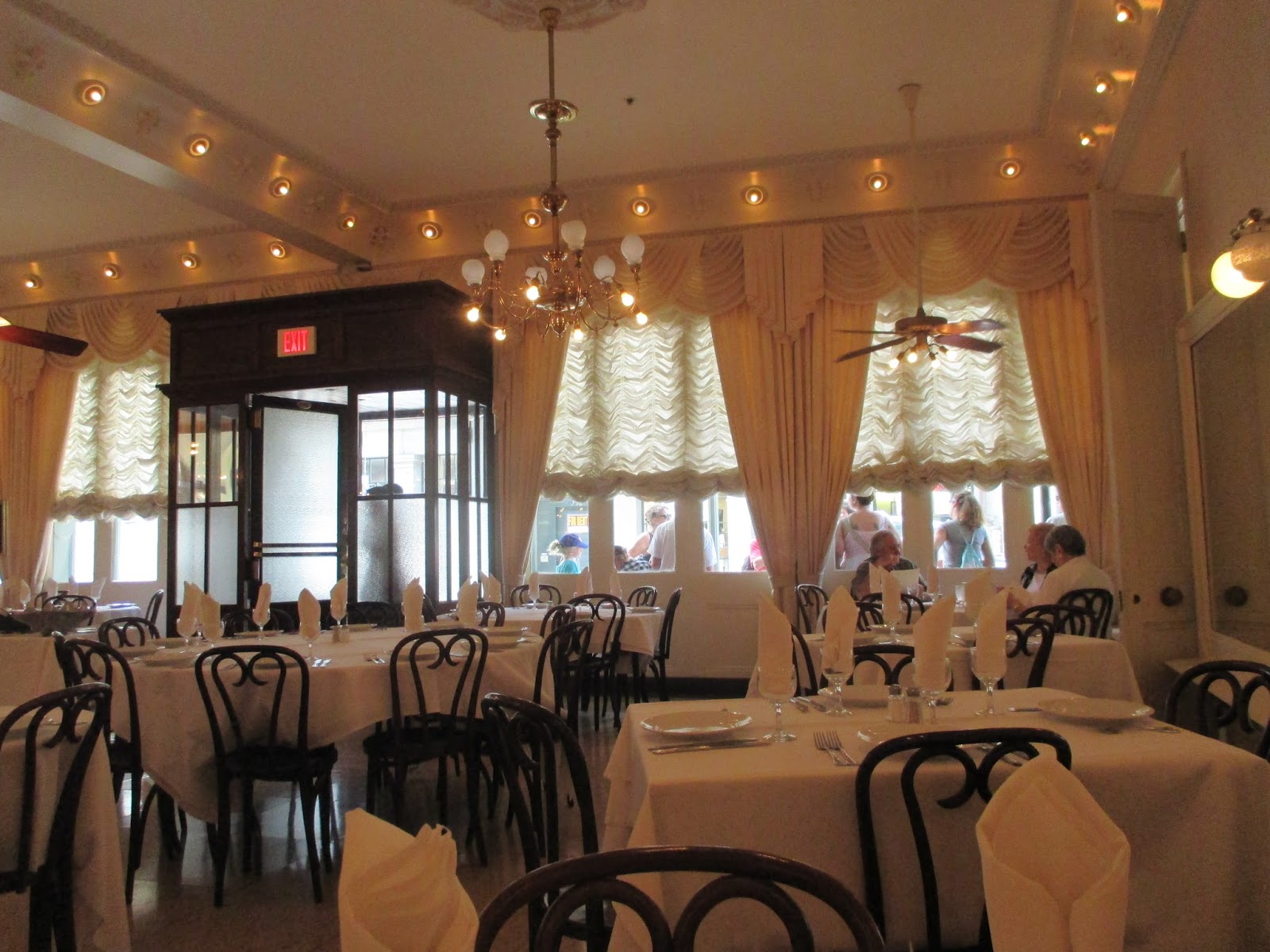
The architecture of the main dining room is amazing with original moldings and columns.
During Prohibition, Antoine's served alcohol in coffee cups that were carried through the ladies restroom into the Mystery Room, one of the themed dining rooms.
The restaurant closed the Japanese Room at the beginning of World War II. It remained closed for 43 years.
Antoine's requires all aspiring servers to spend two to three years in its apprentice program before they "make waiter."
The main dining room at Antoine's
Dinner at Antoine's, a 1947 murder mystery by Frances Parkinson Keyes, begins with a dinner party in the 1840 Room and includes another dinner party at Antoine's near the end. Antoine's itself is not pivotal to the plot, which hinges on the murder of a woman from a snobbish-but-impoverished old Creole family, just as she was beginning to face a serious chronic illness. Rather, Antoine's is part of the ambiance of New Orleans, which Keyes depicts as an exotic, half-foreign city whose ways are not easily understood by outsiders, especially those from the North. The novel is notable for its use of the "least likely person" motif in revealing the identity of the murderer, and for a final plot twist that renders the murder and its aftermath even more tragic. Antoine's is mentioned in other novels by Keyes, including Once on Esplanade, Crescent Carnival, The River Road, and its sequel, Vail D'Alvery. Dinner at Antoine's was Keyes's best-selling and best-known book.
If you are visiting New Orleans "No New Orleans trip is complete" without a "sumptuous" French-Creole meal at this "classic of all classics" (established 1840) "in the heart of the French Quarter", where "oysters Rockefeller was invented"; the "elegant" setting is "composed of many period rooms" that boast "museum-quality artifacts" ("ask for a guided tour"), so even if prices are thoroughly modern, everything else is a "throwback to a more gracious time"
Antoine's Restaurant
713 St Louis St, New Orleans, LA 70130
Tuesday, May 10, 2016
The château de Hopkins in New Orleans before Hurricane Katrina
This photo was used as a Birthday invitation for my birthday of Aug 2th 2003. Posed in the front parlor of my house on Marais street.
From 2000 to 2003 I restored a late 19th century New Orleans shotgun double outside of the French Quarter. This post shows the front two rooms of one side of the house. Both rooms were used as parlors. The front room a more formal parlor and the 2th room a more casual parlor, painted with a 1830's inspired mural by myself. Shortly after these photo's were taking the house was sold and I move back to the French Quarter until Hurricane Katrina came along. I enjoyed restoring this home and furnishing it with antiques and decorating it.
A New Orleans made rosewood Napoleon lll sofa use in the front parlor.
The front parlor with a mix of New Orleans made Victorian and Restoration chairs
New Orleans made French style Restoration period chairs covered in French 1830's Louis Philippe Lyon silk.
1830's New Orleans made side chairs.
Some of my collection of portraits. In the middle over the mantel, a 18th century French pastel. A pair of oil portraits of a husband and wife. Under the portraits 18th and 19th century miniatures.
The circa 1805 French Empire ormolu clock on the front mantel.
A 1850's oil portrait of a gentleman with a 18th century French pastel under the oil portrait. A pair of New Orleans 1830's chairs.
The front wall in between the front door and window
The 2th parlor had a wall mural I painted to look like 1830's French hand-blocked panoramic wallpaper. Titled Monuments of the Mississippi river. The mural shows elegant stately buildings along the Mississippi river starting from New Orleans French Quarter to Natchez Mississippi with plantation homes in between, along with the people from the period. French Creoles, slaves, Free people of color and Indians.
Natchez on the bluff being worked on and 1840's French Boulle and ormolu clock in the Moorish style Old Paris porcelain and makeup Shields
On the mantel a French Louis Philippe 1840's tortoiseshell and ormolu boulle clock in the Moorish style.
Natchez on the bluff being worked on and 1840's French Boulle and ormolu clock in the Moorish style Old Paris porcelain Empire vases and figurines and 1840's makeup Shields.
New Orleans & Place d'Armes
Indians at play over a 1830's Louisiana walnut drop leaf table with Old Paris porcelain punch bowl and Rococo Revival vases.
Louisiana plantations, Free woman of color and pegioners brick octagonal building for pigeons.
Over-mantel hung with 1840's portrait of a Creole woman
Detail of the 1840's portrait.
Windy Hill Manor was constructed in the 1790's by Benijah Osmun. in the center with Concord plantation visible to the left, residence of the first Spanish Governor, Don Manuel Gayoso de Lemos, who built the house in 1794. On the mantel a collection of Old Paris porcelain.
Detail of the 1830's figuren of a Highland Hunter purchased in France.
The dance of Free woman of color with Louisiana plantations in background
New Orleans & Place d'Armes
Louisiana plantations, Free woman of color and pegioners brick octagonal building for pigeons. With rosewood Rococo Revival chairs with original upholstery attributed to Alexander Roux from a South Carolina plantation. A early 19th century Primitive Louisiana Cypress tapered leg table with Old Paris porcelain vase in the Rococo Revival style.
Louisiana plantations, Free woman of color and pegioners brick octagonal building for pigeons. With rosewood Rococo Revival chairs with original upholstery attributed to Alexander Roux from a South Carolina plantation. Primitive Louisiana Cypress tapered leg table with Paris porcelain vase.
This was the shotgun double I bought and restored between 2000-2003 in New Orleans!
Subscribe to:
Posts (Atom)