Thursday, December 2, 2010

America's first monument to George Washington built between 1815-1829, Baltimore, Maryland.

Baltimore's Washington monument built between 1815-1829


I have been lucky to live in the finest Historic Neighborhood in Baltimore called Mount Vernon after George Washington's beloved home. The neighborhood originally was home to the city's most wealthy and fashionable families. I also lived a block away from the first monument to Washington in America known as the Baltimore Washington Monument. The neighborhood had a old world feel to it that reminding me of New Orleans, Europe, New York and Many other places. Many movies are shot here because if it's charm. Three times a day for five years my dog played in Mount Vernon Place one of four parks designed by Frederick Law Olmsted in the 1870's that surround the Washington Monument. Yesterday we toured the State House in Annapolis where George Washington turned over his commission as Commander-in-Chief of the Continental armies. The statue of Washington in Baltimore depicts George turning over his commission. Just as the French artist Claude Monet painted more than thirty views of Rouen Cathedral during different seasons I have photographed the Monument different times of the year. 
Little did I know that when I toured Baltimore and the East Coast in August of 1997 with my French Boyfriend that Hurricane Katrina would bring me to the same streets I walked as a tourist 7 years latter.


Baltimore's Washington Monument pre-dates the more famous one in Washington DC. It is, in fact, the Nation's first civic memorial to George Washington . Built in the neo-classical style, the 178-foot monument was designed by architect Robert Mills and was completed in 1829, fourteen years after construction began. Mills also designed our more famous sister monument in Washington, D.C. which opened in 1855.

The marble tower rises 178 feet (the DC one is 555 feet tall) from the highest point in Baltimore. At one time ships entering the harbor could see the monument, which is only 10 blocks from the Inner Harbor. Today downtown's skyscrapers block the vista.


Just 10 years after George Washington died in 1809, a group of citizens organized a lottery to raise $100,000 for Baltimore's monument. Robert Mills, who later became architect of the other Washington Monument, won the commission to design Baltimore's tribute to Washington and $500.00. Of the entries received, the Managers chose that of Robert Mills, the most grand (and expensive) design submitted: a massive column resting on a base with balconies at several levels, inscriptions, and a crowning statue representing Washington, dressed as a Roman warrior, riding in a horse-drawn chariot. Mills, a native of Charleston, South Carolina, who prided himself on being the first entirely American-trained architect, was awarded the commission for the Monument in 1815. Begun in 1815, the grandiose design was scaled back several times before its completion in 1829. A Doric column rising from a square base, the monument is topped with a statue of Washington in a Roman toga.


When the winning design was announced, the owners of the houses surrounding the proposed site rose in opposition, fearing that such a tall column would surely fall over on them, and even if it remained standing, would probably attract lightning. Colonel John Eager Howard, Baltimore's own Revolutionary hero, came to the rescue, donating land from his immense estate, Belvidere, for the placement of the monument honoring his former Commander-in-Chief. The donated site, then called Howard's Woods, was a hill well north of the Baltimore town of 1815, where a falling statue would be unlikely to harm anyone. Thus it was that on July 4, 1815, a crowd estimated at between 25,000 and 30,000 townspeople and assorted dignitaries assembled at the site of the proposed monument for the laying of the cornerstone.


Construction of the Monument began in 1815 and continued for nearly 15 years. Both the marble for the column and the fine white marble for the statue of Washington atop the column came from Baltimore County quaries. By 1824, the column and the capital to hold the crowning statue had been completed, but soaring costs--nearly twice the $100,000 authorized by the legislature--had forced Mills to simplify the design significantly, resulting in the unadorned shaft we see today.


In 1826, the project Managers held another competition calling for designs from sculptors for the statue of George Washington to be placed on top of the column. After reviewing the few submissions, the Managers awarded the statue commission to Enrico Causici of Verona, Italy, who had sculpted several panels of the Rotunda of the United States Capitol. Causici created the statue of Washington out of three blocks of marble weighing about seven tons each. Financial considerations having eliminated the Roman chariot statue design, the sculptor instead depicted Washington resigning his commission as Commander-in-Chief of the Continental armies, a most appropriate subject as the incident took place in the senate chamber of the State House in Annapolis, Maryland, where the United States Congress sat for a brief time in late 1783.


To execute the daunting task of raising the statue (approximately 16 feet high) to the top of a 160 foot high column, Causici and Mills called upon Captain James D. Woodside of the Washington Navy Yard, a rigging specialist. Captain Woodside devised an ingenious system of pulleys, levers and braces, and successfully hoisted the lower two portions of the statue into place. Finally, on November 25, 1829, the populace once again assembled in Howard's Woods as the final section of the statue was raised to the top of the column during the Monument's dedication ceremony.


William Rusk, in his book "Art in Baltimore: Monuments and Memorials", tells the following story about the raising of Italian sculptor Enrico Causici's marble statue of Washington in 1829. "Tradition recalls a prodigy occurring when the statue was raised to the summit of the monument - a shooting star dashed across the sky and an eagle lit on the head of the settling general."

The monument is referenced by Herman Melville (as Ishmael) in Chapter XXXV (The Mast-Head) of Moby-Dick, "Great Washington, too, stands high aloft on his towering main-mast in Baltimore, and like one of Hercules' pillars, his column marks that point of human grandeur beyond which few mortals will go."


Visitors can climb its 228 steps for one of Baltimore's best views from a small observation area! In the base, a small museum with chronicles the history of the monument. Admission is $1.

Enrico Causici of Verona, Italy, who had sculpted several panels of the Rotunda of the United States Capitol. Causici created the statue of Washington out of three blocks of marble weighing about seven tons each. Financial considerations having eliminated the Roman chariot statue design, the sculptor instead depicted Washington resigning his commission as Commander-in-Chief of the Continental armies


George Washington by Enrico Causici seen thru a 1840's Greek Revival building on the square


George Washington with a Roman haircut and a toga by Giuseppe Ceracchi an Italian sculptor, active in a Neoclassic style in Italy, England and the nascent United States, who was a passionate republican during the American and French revolutions.


The George Washington museum at the base of the monument


The George Washington museum at the base of the monument


A original lottery ticket to raise $100,000 for Baltimore's monument


Graffiti on the way up to the top.


The beautiful brick work under the George Washington statue


One of Baltimore's best views


President Abraham Lincoln was invited and attended dinner at the house strait ahead to the right 2th from the corner


Neoclassical Cast iron


The iron fence around the base was designed by Mills and added in 1838. It contains some of the symbolism that had been deleted from the column due to cost considerations.


One of the four depictions of War, Peace, Order and Force on the square given to the City by Walters in the 1880s, the Walters Art Gallery owns more than 150 other Barye bronzes as well as pieces of his work in other media.


The iron fence around the base was designed by Mills and added in 1838. It contains some of the symbolism that had been deleted from the column due to cost considerations.


Spring time in Baltimore


Winter


Sunrise

L'indiscret c 1780's by Louis Léopold Boilly

L'indiscret c 1780's by Louis Léopold Boilly

Portrait of Artist François Gérard, aged 20, ca 1790 by Antoine-Jean Gros.

Portrait of Artist François Gérard, aged 20, ca 1790 by Antoine-Jean Gros.

Wednesday, December 1, 2010

Allégorie de la libération des esclaves d'Alger par Jérôme Bonaparte 1806 by François-André Vincent

Allégorie de la libération des esclaves d'Alger par Jérôme Bonaparte 1806 by François-André Vincent

Maryland's State House the oldest state capitol still in continuous legislative use

The Maryland State House is located in Annapolis, Maryland and is the oldest state capitol in continuous legislative use, dating to 1772 and built in the Georgian style. It houses the Maryland General Assembly. The capitol has the distinction of being topped by the largest wooden dome built without nails in the nation.

Construction began in 1772 on the Maryland State House and was not completed until 1779 due to the ongoing American Revolutionary War. The statehouse was designed by Joseph Horatio Anderson, who was a noted architect of the time. The two-story building is of brick construction in the middle of State Circle. The building is designed in the popular Georgian style of the day. A small portico juts out from the center of the building and is topped by a pediment, two high arched windows frame the entrance. On both floors, large rectangular windows line the facade. A cornice is topped by another pediment and the sloping roof gives way for a central octagonal drum atop which rests a dome. The large dome is topped by a balustrade balcony, another octagonal drum and a lantern capped by a lightning rod. The rod was constructed and grounded according to the direct specifications of its inventor, Benjamin Franklin. The dome of the statehouse is depicted on the Maryland state quarter.

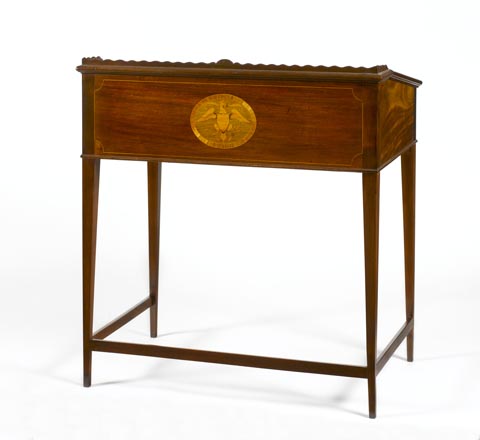
To the right of the entrance is the old Senate Chamber. Chairs and desks were added to the room in the exact number (16) as originally furbished. The desk for the president is an original piece made by John Shaw in 1797.


It was in the Old Senate Chamber that George Washington famously resigned his commission as commander in chief of the Continental Army on December 23, 1783. A mannequin of George Washington stands in period clothing at the head of the room.From November 26, 1783 to August 13, 1784, Annapolis served as the United States capital. The Congress of the Confederation met in the Maryland State House. Subsequently, Annapolis was a candidate to become the new permanent national capital before Washington, D.C. was built.

The United States District Court for the District of Maryland met there for the first decade of its existence. In 1800, judge Samuel Chase tried a local postmaster for embezzlement and sentenced him to thirty-nine lashes. In order to carry out the sentence, the defendant was tied to one of the statehouse columns.

MARYLAND STATE HOUSE, attributed to Charles Willson Peale (1741-1827), 1789


This engraving, attributed to Charles Willson Peale, was published in the February 1789 issue of the Columbian Magazine. In addition to the new State House with its recently completed dome, on the far left is the home of John Shaw. To the right of the State House are the Old Council Chamber and Ball Room built in 1718, the octagonal outdoor privy, known as the "temple," constructed in the 1780s and the Treasury Building built in 1729.


The main hall of the State House before construction of the 1902-1906 addition, and after the ill-fated renovations of the 1860s (note the falling plaster under the right staircase).


The 18th century wood and plaster dome in the Georgian style


18th century Georgian Corinthian columns


The capitol has the distinction of being topped by the largest wooden dome built without nails in the nation.


Ornate detail of the 18th century wood and plaster dome in the Georgian style


Large Corinthian columns support the arches bracing the large dome above. A balustrade lines the second floor balcony.


The capitol has the distinction of being topped by the largest wooden dome built without nails in the nation.


Large Corinthian columns support the arches bracing the large dome above. A balustrade lines the second floor balcony. Note men in black


Large Corinthian columns support the arches bracing the large dome above. A balustrade lines the second floor balcony.


Large Corinthian columns support the arches bracing the large dome above. A balustrade lines the second floor balcony.


 The Old Senate Chamber that George Washington famously resigned his commission as commander in chief of the Continental Army on December 23, 1783.


 The Charles Willson Peale portrait of Washington


 The Old Senate Chamber that George Washington famously resigned his commission as commander in chief of the Continental Army on December 23, 1783.


Detail of carved wood and plaster work in The Old Senate Chamber


Detail of carved wood and plaster work in The Old Senate Chamber


It was in the Old Senate Chamber that George Washington famously resigned his commission as commander in chief of the Continental Army on December 23, 1783. A mannequin of George Washington stands in period clothing at the head of the room.


John Shaw (1745-1829), the noted Annapolis cabinetmaker, more than any single person was responsible for the appearance of the exterior and interior of the State House from the 1770s to the early of the nineteenth century. He cared for the grounds, illuminated the State House for festive occasions, supplied furnishings, made emergency repairs, and undertook normal maintenance. There was very little he and the people he hired didn't do. When Joseph Clark, the contractor for the dome, needed a carpenter for the shell, Shaw was hired. When Clark left the project, John Shaw took charge of overseeing the interior plasterwork.


John Shaw, or craftsmen he trained including Washington and William Tuck, made most of the earliest furniture for the Senate and House of Delegates' Chambers, although in November 1783 no one in Annapolis had enough time to make sufficient chairs for Congress. Six dozen "Windsor chairs" had to be rush-ordered from Baltimore.


In 1797, the Senate paid John Shaw to make individual desks for its members, but by 1807, the House also contracted with him for "the fitting up and repairing the House of Delegates Room" with the room to be "laid off in circular form, and . . . the [new] desks to be raised one above the other, as nearly like the room occupied by Congress as may be practicable." The desks Shaw provided remained in the State House until about 1835, when they were given to Baltimore cabinetmaker John Needles as partial payment for new furnishings.


His many years as the first superintendent of buildings and grounds did not make John Shaw a wealthy man. When he died in 1829, at the age of 84, he was highly esteemed but not rich. The Maryland Gazette described him as "not only one of the oldest and [most] respectable inhabitants of this city . . . but also] one of the most useful of them. He was gifted by nature with strength, as well as fortitude of mind, and possessed a degree of self-control which [he] rarely permitted . . . to be disturbed. Thus happily constituted, he pursued his way-content. His whole conduct remained free from reproach and he descended into the grave in peace with the human family.[having lived] a life characterized by industry, temperance, strict integrity, and punctual attention to religious duty.."


President's Desk

Probably made by William Tuck (c. 1774-1813) in the shop of John Shaw
Date: 1797
Medium: Mahogany, mahogany veneer, and dark and lightwood inlay with tulip poplar


President's Armchair


Attributed to the shop of John Shaw
Date: c. 1797
Medium: Mahogany and dark and lightwood inlays with tulip poplar and white oak


Desk


Attributed to the shop of John Shaw
Date: c. 1797
Medium: Mahogany, mahogany veneer, and dark and lightwood inlay with tulip poplar and yellow pine


Armchair


Attributed to the shop of John Shaw
Date: c. 1797
Medium: Mahogany with dark and lightwood inlay with tulip poplar


The Senate chamber is located in a wing added to the original structure between 1902 and 1905. The room is illuminated by a Tiffany-style skylight above. Red carpet emlazoned with the state seal covers the entire floor. Large Ionic columns line the walls as well as supports the viewing gallery. The marble lining the walls and the columns are flecked with rust and black colors, Maryland's official colors.


Two statues flank the podium and are two famous Marylanders. The one is John Hanson, the first president under the Articles of Confederation, the other is Charles Carroll, one of the signers of the Declaration of Independence. Four portraits of the Declaration of Independence signatories for Maryland hang from the walls: William Paca, Thomas Stone, Samuel Chase, and Charles Carroll.


The House of Delegates working chamber is also in the new wing to the building. The carpet is a navy blue and designed with a diamond and olive sheaths. The same rust and black marble lines the chamber and forms the Ionic columns lining the walls. A spectators gallery rises above the rostrum. The speaker sits in front of a broken marble pediment supporting a clock. Portraits of former Speakers of the House hang from the walls.

The month of December will be a exciting month here at the blog!

Styling  by Andrew Hopkins. Collection of early 19th century Empire Old Paris porcelain. Early 19th century American coin silver spoons. The hand colored engraving is of Marie Antoinette's last farewell to her son late 18th century early 19th century.


The month of December will be a exciting month here at the blog! We will be exploring what is "Southern Style" and "Creole Style". Creole Christmas, The Decorative arts at Winterthur Museum, Gardens & Library, in Winterthur, DE, a walking tour around Paris France, Early American porcelain made by Tucker in the Philadelphia Museum of Art. The Parc & Château de Bagatelle in Paris, France. The Richards DAR house museum in Mobile, Alabama. The Longfellow House Museum in Salem, Massachusetts. A walking tour of Historic Boston and Salem, Massachusetts. A look at how the Turkish Style influenced 19th century French Decorative arts. Decorative arts at the Peabody Essex Museum in Salem. Hampton mansion built 1790 in Towson, Maryland. 18th century Paris one stop shopping the marchand-mercier .French Marie Queen Marie Antoinette's porcelain factory in Paris Rue Thiroux, America's first Washington monument in Baltimore, Maryland. Maryland's State House the oldest state capitol still in continuous legislative use and is the only state house to have ever served as the nation's capitol, and much much more. Pull up a seat and take a French Empire porcelain cup of French roast coffee!

family game of checkers ("jeu des dames") by French artist Louis-Léopold Boilly, ca. 1803

A family game of checkers ("jeu des dames") by French artist Louis-Léopold Boilly, ca. 1803

Painting of a family game of checkers ("jeu des dames") by French artist Louis-Léopold Boilly, ca. 1803

Shows the Paris idea, under strong neoclassical fashion influences in the years around 1800, of attire for females of different ages. On the floor, the family dog and cat don't seem to be getting along.